
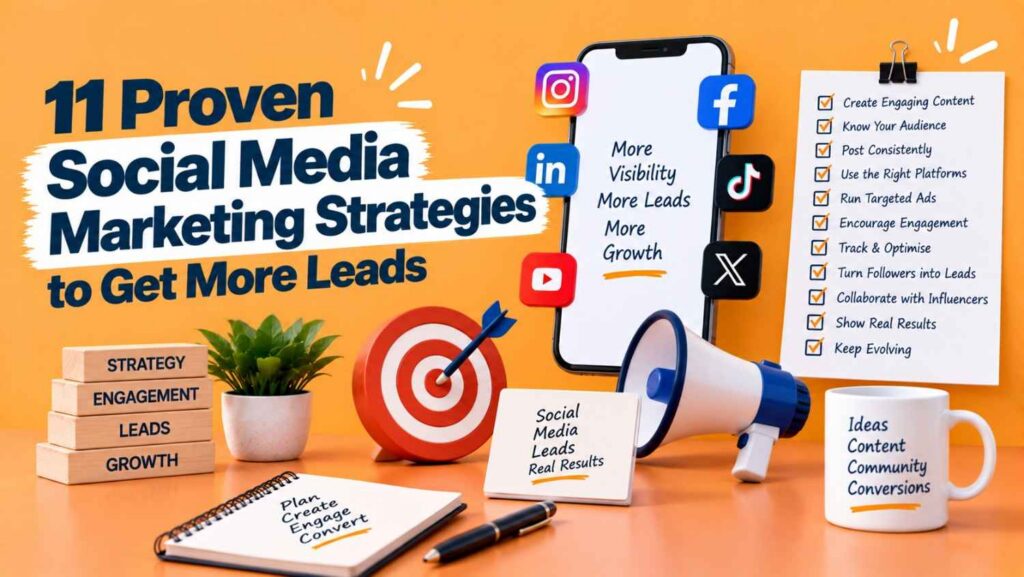

The 11 social media marketing strategies in this guide are built for one job: turning followers into genuine leads. Social media has stopped being a place brands simply “show up” and started being one of the most reliable channels for generating genuine business leads. Around two-thirds of marketers now point to lead generation as the main benefit they get from their social channels, and platforms such as Facebook, LinkedIn and Instagram remain the three most widely used networks for reaching prospective customers (HubSpot, 2026 State of Marketing Report).
The problem most businesses run into isn’t a lack of effort, it’s a lack of strategy. Posting regularly without a clear plan for turning followers into enquiries rarely moves the needle. If you want to see the flip side of this first, our breakdown of 10 social media marketing mistakes killing your growth covers the traps this guide is designed to help you avoid. This guide walks through 11 proven, practical strategies you can use to turn your social media presence into a genuine source of leads, plus the common mistakes to avoid and how to measure whether it’s actually working.
1. Define Your Target Audience
Every effective lead generation strategy starts with clarity about who you’re trying to reach. Before creating a single post, map out your ideal customer: their industry or lifestyle, the problems they’re trying to solve, where they spend time online, and what kind of content earns their attention.
A useful way to do this is to build 2 to 3 detailed buyer personas covering demographics, goals, objections and preferred platforms. Skipping this step is one of the most common reasons social campaigns generate likes but not leads. You end up talking to everyone, which usually means you’re not really speaking to anyone.
2. Set Clear Lead Generation Goals
“Get more leads” isn’t a strategy on its own, it’s a wish. Effective social media lead generation needs specific, measurable goals: a target number of qualified leads per month, a target cost per lead, or a target conversion rate from social traffic to enquiry.
Setting these goals upfront also tells you which metrics actually matter. Vanity metrics like follower count or likes feel good, but they don’t pay the bills. Enquiries, demo bookings and sales-qualified leads do.
3. Choose the Right Social Media Platforms
Trying to be active everywhere is a fast way to spread your team too thin. The right platform depends entirely on your audience and your industry. For B2B businesses, LinkedIn dominates: the vast majority of B2B marketers use it for lead generation, and it’s estimated to drive the large majority of all B2B leads sourced through social media (Sprout Social).
For B2C brands, Instagram, Facebook and increasingly TikTok tend to perform better, particularly for visually-driven products and younger audiences. Rather than spreading your budget thin across five platforms, identify the two where your audience is genuinely active and go deep.
4. Create Content Around Customer Problems
The brands that generate the most leads on social media aren’t the ones talking about themselves. They’re the ones consistently answering the questions their audience is already asking. Content built around real customer pain points (how-to guides, myth-busting posts, before and after case studies) builds trust long before someone is ready to buy.
This is also why blog content and social media work so well together: blog posts remain one of the highest-value content formats for lead generation because they let you go deeper on a problem than a single post can (HubSpot). Repurposing your blog content into carousels, short videos and threads gives you a steady stream of problem-focused social content without starting from scratch every time.
5. Use Short-Form Video to Attract Attention
Short-form video isn’t just popular, it’s the format marketers now report gets the best return of any content type. It’s the most-used content format overall going into 2026, and it’s rated as the top ROI-driving format by a wide margin over long-form video and live streaming (HubSpot State of Marketing Report, 2026).
The reason is simple: short-form video is fast to consume, algorithm-friendly, and gives you multiple opportunities within 15 to 60 seconds to demonstrate expertise, show product value or build personality into your brand. Whether it’s Reels, TikToks or YouTube Shorts, this format should be a core part of any 2026 social lead generation strategy, not an afterthought.
6. Create Strong Calls to Action (CTAs)
A brilliant piece of content with no clear next step is a missed lead. Every post that has genuine commercial intent behind it should tell the viewer exactly what to do next, whether that’s “Book a free consultation,” “Download the guide,” or “DM us for pricing,” rather than leaving them to work it out themselves.
Strong CTAs are specific, low-friction and matched to where the person is in their journey. Someone watching their first video from your brand isn’t ready for “Buy now,” but they might click “Learn more” or “Save this for later.”
7. Turn Engagement Into Conversations
Comments, DMs and saves are the warmest signals social media gives you, and they’re routinely wasted. A comment left unanswered, or a DM that gets a generic reply after three days, is a lead going cold in real time.
Building a habit of moving engaged followers into direct conversation, through comment replies that invite a DM, or automated (but personal-feeling) message flows, is one of the simplest ways to convert interest into pipeline without spending anything extra on ads.
8. Use Reviews, Testimonials & Case Studies
Trust is the biggest barrier between a follower and a lead, and social proof is the fastest way to remove it. Around 89% of people say they trust personal recommendations more than advertising, which is exactly why testimonials, case studies and user-generated content consistently outperform straight promotional posts (Snov.io Lead Generation Statistics, 2026).
Turn client wins into short video testimonials, before and after results posts, or carousel case studies that walk through a real problem you solved. These formats do double duty: they build credibility and they give prospective customers a concrete reason to reach out.
9. Combine Organic & Paid Social Media Marketing
Organic content builds trust and authority over time. Paid social gets your best-performing content in front of a much larger, more targeted audience right now. The businesses generating the most consistent leads treat these as complementary tactics, not competing ones.
A common, effective approach is to use organic posts to test which messages and formats resonate, then put paid budget behind the proven winners to accelerate reach and retarget people who’ve already engaged. Platforms like Meta Ads Manager and LinkedIn Campaign Manager both make it straightforward to retarget warm audiences who’ve interacted with your organic content.
10. Build a Social Media Lead Generation Funnel
Random acts of posting rarely generate consistent leads. A funnel does. A simple, effective structure looks like this:
- Top of funnel: Educational and entertaining content that builds awareness and reach (short-form video, tips, industry insights)
- Middle of funnel: Deeper content that builds trust (case studies, testimonials, behind-the-scenes, webinars)
- Bottom of funnel: Direct, action-oriented content with a clear offer and CTA (free consultations, demos, limited-time offers)
Mapping your content calendar against these three stages, rather than posting whatever comes to mind that day, is one of the fastest ways to turn a scattered social presence into a genuine lead generation channel.
11. Track Leads, Conversions & ROI
You can’t improve what you don’t measure. Our guide on how much social media management costs is a useful companion here if you’re also weighing whether to bring this tracking in house or hand it to a team. Use UTM tracking links, platform-native lead forms, and your CRM to trace which posts, campaigns and platforms are actually producing leads, not just engagement. Tools like Google Analytics and native platform insights (Meta Business Suite, LinkedIn Analytics) should be checked regularly, not just glanced at monthly.
At a minimum, track: leads generated per platform, cost per lead (for paid activity), lead-to-customer conversion rate, and which content formats and topics are driving the most enquiries. This data should directly shape next month’s content plan.
Common Social Media Marketing Mistakes to Avoid
- Posting without a strategy. Content with no goal rarely produces measurable results.
- Focusing on vanity metrics. Followers and likes don’t equal revenue.
- Being on every platform at once. Spreading effort too thin lowers quality everywhere.
- Ignoring comments and DMs. The warmest leads are often hiding in your inbox.
- Overly promotional content. Audiences tune out constant “buy from us” messaging.
- No consistent posting schedule. Algorithms and audiences both reward consistency.
- Skipping paid amplification entirely. Even a small, targeted budget can meaningfully extend organic reach.
- Not tracking results. Without data, you’re guessing rather than improving.
Social Media Marketing for Local Businesses
National strategy matters, but local businesses win leads by being unmistakably relevant to their area: local landmarks, local events, local customer stories, and location-specific keywords in captions and profiles. Below is how this plays out across the regions we work in most.
Social Media Marketing in Kent
Kent’s mix of market towns, coastal communities and commuter belt means local businesses benefit from social content that speaks to a genuinely local audience, think seasonal events, local partnerships and geo-targeted paid campaigns aimed at towns like Maidstone, Canterbury and Tunbridge Wells. See our social media marketing agency in Kent page for how we approach this locally.
Social Media Marketing in London
London is one of the most competitive social media markets in the UK, which makes precise targeting and a distinctive brand voice essential. Local businesses here often see the strongest results from hyper-local paid targeting combined with borough-specific content and influencer partnerships. See our social media marketing agency in London page for how we approach this locally.
Social Media Marketing in Sheffield
Sheffield’s strong sense of local identity and community makes it well suited to authentic, community-first social content: supporting local causes, showcasing the city’s independent business scene, and building relationships rather than pushing hard sales messaging. See our social media marketing agency in Sheffield page for how we approach this locally.
Social Media Marketing in Glasgow
Glasgow audiences respond strongly to personality-led, conversational brand voices. Businesses that lean into local humour and community pride on social media tend to build stronger engagement, which, paired with clear CTAs, converts well into local leads. See our social media marketing agency in Glasgow page for how we approach this locally.
Social Media Marketing in Birmingham
As one of the UK’s largest and most diverse cities, Birmingham rewards businesses that segment their social content by audience and neighbourhood rather than using a single one-size-fits-all message across the whole city. See our social media marketing agency in Birmingham page for how we approach this locally.
Social Media Marketing in Manchester
Manchester’s fast-growing digital and creative scene means competition for attention is high, but it also means audiences are highly engaged with well-produced content, particularly short-form video and behind-the-scenes brand storytelling. See our social media marketing agency in Manchester page for how we approach this locally.
How to Measure Social Media Marketing Success
Success on social media should be judged against the goals you set in step 2, not against generic industry benchmarks. That said, the metrics that matter most for lead generation typically include:
- Lead volume and quality: how many leads, and how many were sales-qualified
- Cost per lead: particularly important for any paid social activity
- Engagement rate: a leading indicator of content quality, even though it isn’t a lead metric itself
- Click-through rate: how effectively your CTAs are moving people off-platform
- Conversion rate: the percentage of social-sourced leads that become customers
- Follower growth in your target audience: quality of growth matters more than raw numbers
Reviewing these monthly, and adjusting your content and platform mix based on what the data shows, is what separates social media marketing that generates leads from social media marketing that just generates noise.
Conclusion: Social Media Marketing Strategies That Bring in Leads
Social media lead generation isn’t about luck, virality, or posting more often than your competitors. It’s about strategy, consistency and constantly refining what works based on real data. From defining your audience and building a proper funnel, to using short-form video and social proof to build trust, each of the 11 strategies above plays a role in turning followers into genuine business opportunities.
The businesses that win on social media in 2026 are the ones treating it as a measurable, ROI-driven channel, not just a marketing checkbox.
Want a Social Media Strategy Built Around Leads, Not Just Likes?
Our team creates and manages results-focused social media campaigns for businesses across the UK, from strategy and content creation to paid amplification and reporting. Schedule a call with our team, or reach out through our contact page to talk about your goals and see how we can help you turn social media into a genuine source of new business.
Take a look at our pricing to see what’s included at every level.
