
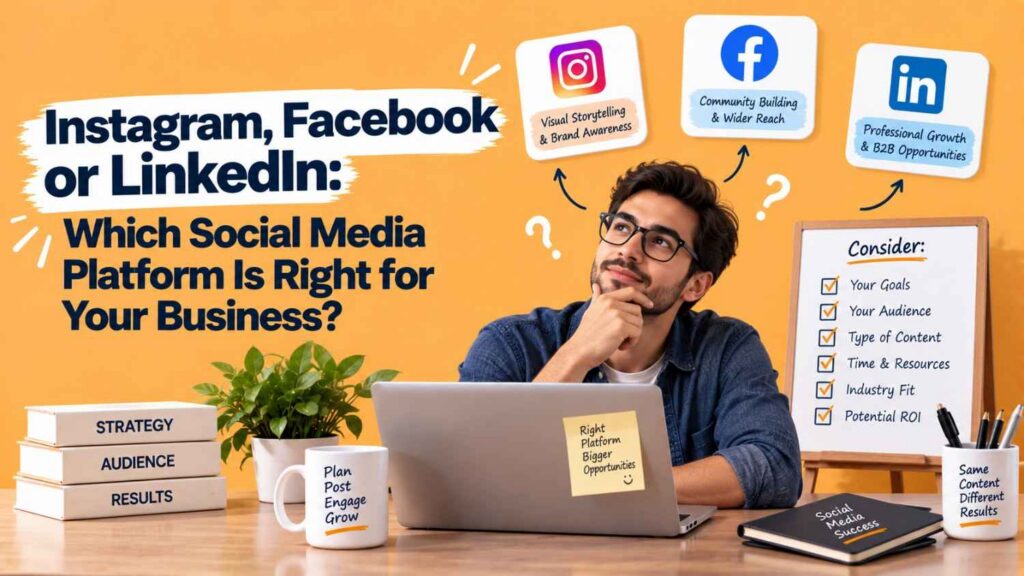

Choosing a social media platform comes down to your audience and your buying decision, not to which app you personally prefer. Instagram, Facebook and LinkedIn each reach a different audience and reward a different type of content. LinkedIn wins for B2B authority and decision-maker access, Facebook wins for local trust and precise ad targeting, and Instagram wins for visual storytelling and short-form video. Most businesses do best mastering one or two platforms rather than spreading thin across all three.
- LinkedIn is the strongest social media platform for B2B companies, consultants, agencies and recruiting.
- Facebook works best for local businesses, community building and ad retargeting.
- Instagram suits visually-driven products and short-form video, Reels especially.
- Posting frequency matters far less than posting on the platform your audience actually uses.
- A single piece of content can usually be adapted across all three platforms with light editing.
- It’s usually better to master one platform first than to spread thin across three from day one.
Why Social Media Platform Choice Matters More Than Posting Frequency
One of the most common mistakes we cover in our guide to social media marketing mistakes killing business growth is treating every platform the same, and it’s just as damaging as not posting enough. Posting five times a day on the wrong social media platform will always underperform posting three times a week on the right one.
Before creating content, it helps to answer three questions. Where does your actual target audience already spend time, not where you personally enjoy scrolling? What kind of buying decision are you supporting: a considered B2B purchase, a local service, or an impulse-driven consumer product? And what content can you realistically produce on an ongoing basis? A social media platform you can’t sustain won’t deliver results, no matter how well it fits your audience.

LinkedIn: Best for B2B, Authority and Decision-Makers
LinkedIn is built around professional identity, which makes it the strongest social media platform for reaching business decision-makers directly. The vast majority of B2B marketers use it for lead generation, and it’s widely reported to drive the large majority of all B2B leads sourced through social media (Sprout Social).
LinkedIn works best for:
- B2B companies, consultants, agencies and professional services
- Thought leadership, industry commentary and company updates
- Case studies, whitepapers and long-form insight posts
- Recruiting and employer branding
Posting rhythm: Quality over volume. Three to four well-considered posts a week tends to outperform daily low-effort updates.
Content that performs: Text-based insight posts, carousels breaking down a process or lesson, and video from real people at the company, since executive-authored content tends to significantly outperform generic brand page posts.
Facebook: Best for Local Trust, Community and Retargeting
Facebook’s strength is depth of targeting and its role as a trust-building hub, especially for local and community-based businesses. It remains one of the most widely used platforms by marketers overall, and its advertising platform offers some of the most precise local and interest-based targeting available anywhere (HubSpot).
Facebook works best for:
- Local businesses: trades, clinics, restaurants, salons, retail
- Community groups, events and customer service via Messenger
- Slightly older demographics compared with Instagram and TikTok
- Retargeting website visitors and warm audiences with paid ads
Posting rhythm: Three to five times a week, plus active monitoring of comments, reviews and Messenger.
Content that performs: Customer reviews and testimonials, local event promotion, behind-the-scenes updates, and short video. Facebook groups can also be a strong tool for building community around a brand or niche.
Instagram: Best for Visual Storytelling and Short-Form Video
Instagram is the social media platform built for visual brands and, increasingly, for video. Short-form video is now the single most effective content format across social media, with marketers rating it the top format for both usage and return on investment going into 2026 (HubSpot State of Marketing Report, 2026).
Instagram works best for:
- Visually-driven products: fashion, food, beauty, home, fitness
- Brand personality and behind-the-scenes content, for both B2C and B2B
- Reaching younger to mid-age adult audiences
- Influencer and creator partnerships
Posting rhythm: Higher frequency than LinkedIn or Facebook, four to six times a week including Stories and Reels.
Content that performs: Reels, carousels that tell a mini-story or walk through a process, and Stories used for polls, Q&As and quick behind-the-scenes moments.
How to Choose a Social Media Platform: A Simple Decision Framework
If you can only focus on one or two platforms to start, use this as a rough guide to picking your first social media platform:
- B2B, professional services, high-value sales: Start with LinkedIn, add Instagram for brand personality if you have capacity
- Local business, service-based, community-driven: Start with Facebook, add Instagram for visual reach
- Product-based, visually strong, younger audience: Start with Instagram, add Facebook for retargeting and local trust
- Have the resources to run all three: Use LinkedIn for authority and B2B leads, Facebook for local trust and retargeting, and Instagram for visual reach and video-driven engagement

Once you’ve settled on a platform mix, our guide to proven social media marketing strategies to get more leads covers how to turn that presence into actual pipeline rather than just followers.
Making Each Social Media Platform Work Together
You don’t need entirely separate content for each social media platform. A single piece of content can usually be adapted across all three with light editing. A client case study becomes a LinkedIn insight post, a Facebook customer story with a photo, and an Instagram carousel.
A short video filmed once can be trimmed for a LinkedIn update, posted natively on Facebook, and published as an Instagram Reel. A testimonial can be quoted on LinkedIn, turned into a review graphic on Facebook, and used as a Stories highlight on Instagram. This kind of repurposing keeps content output manageable while still giving each platform something suited to how its audience actually uses it.
How to Tell If a Social Media Platform Is Working
Track platform-specific metrics rather than comparing the three directly: engagement rate and reach on Instagram, click-through and conversion rate from Facebook ads, and lead quality plus profile engagement on LinkedIn. Judge each social media platform against the goal you set for it.
Give a new social media platform at least three months of consistent posting before judging results, since organic reach and audience trust take time to build. If you’re running paid ads, you can usually get a clearer read within two to four weeks.
Common Mistakes When Choosing a Social Media Platform
- Copy-pasting the same post everywhere. Each platform has different norms and audience expectations, identical content usually underperforms on at least one of them.
- Choosing a social media platform because a competitor is on it. Your audience and sales process should drive the decision, not what looks impressive.
- Spreading thin across all three from day one. It’s usually better to master one platform first, then expand once you have a repeatable content process.
- Ignoring paid amplification. Even a modest budget on Facebook or LinkedIn ads can significantly extend the reach of your best organic content.
What Running More Platforms Actually Costs
Our breakdown of what social media management costs in 2026 is worth reading before you commit to running all three platforms at once, since managing Instagram alone costs meaningfully less than managing Instagram, Facebook and LinkedIn together with separate content and reporting for each. Factoring in that cost upfront often makes the case for starting with a single social media platform even clearer.
Social Media Platform Choices in Practice: Examples
These are illustrative scenarios, not real client case studies.
- A B2B software consultancy moves its main effort from Instagram to LinkedIn after realising its buyers research solutions at work, not while scrolling for inspiration in the evening. Within two quarters, LinkedIn is generating more qualified leads than the company’s website contact form.
- An independent hair salon focuses entirely on Facebook and Instagram, using Facebook for local reviews, events and retargeting ads and Instagram for behind-the-scenes video and finished-look photography, rather than attempting a LinkedIn presence that has no relevance to its customers.
- A fashion accessories brand builds its early growth on Instagram Reels and influencer partnerships, only adding Facebook later once it needs retargeting ads to bring warm visitors back to convert.
Local Social Media Marketing Support
If you’d rather have a specialist manage your platform mix for you, we work with local businesses across the UK to build and run Instagram, Facebook and LinkedIn strategies suited to their area and audience:
- Social Media Marketing Agency in Kent
- Social Media Marketing Agency in London
- Social Media Marketing Agency in Sheffield
- Social Media Marketing Agency in Glasgow
- Social Media Marketing Agency in Birmingham
- Social Media Marketing Agency in Manchester
Conclusion
There’s no single “best” social media platform, only the best platform for your specific audience, offer and content capacity. LinkedIn wins for B2B authority and decision-maker access, Facebook wins for local trust and precise ad targeting, and Instagram wins for visual storytelling and short-form video reach. Most businesses don’t need to be everywhere, they need to be consistently excellent on the one or two platforms where their actual customers are paying attention.
Ready to Find the Right Platform Mix for Your Business?
Not sure which social media platform is the right fit for your business, or trying to manage all three without enough hours in the day? Our team builds and runs social media strategies across Instagram, Facebook and LinkedIn tailored to your audience and goals. Schedule a call with our team, or reach out through our contact page to talk through your business and find the right platform mix for genuine growth.
Take a look at our pricing to see what’s included at every level.
