Atomic Logo

What’s the Difference Between SEO and AIO (AI Optimization)?

A few years ago, “search” meant typing something into Google and clicking a blue link. Now it just as often means asking ChatGPT a question and reading the answer it gives you, with maybe a couple of source links tucked underneath. That shift is why a new acronym keeps showing up next to SEO: AIO, or AI Optimization. If you write online, run a business site, or just want to understand why your traffic patterns look different than they used to, this distinction actually matters.

Here’s the honest version of what’s changed, what hasn’t, and what to do about it.

Why this matters right now

Google’s AI Overviews now sit above the traditional results on a huge share of searches, and platforms like ChatGPT, Perplexity, and Copilot answer questions directly instead of sending people to a page. Google has said publicly that the same content and structured data that ranks in normal search results is what surfaces in AI Overviews, pulled from the same index and judged by the same quality signals. That’s a meaningful data point, because it means AIO isn’t a separate system you’re gaming. It’s an extension of the same one.

But the experience for a reader has changed even if the underlying signals haven’t. Fewer people click through when an AI system already gave them the answer. That means visibility and traffic are no longer the same thing, and treating them as the same thing is where a lot of confusion starts.

SEO: what it actually is

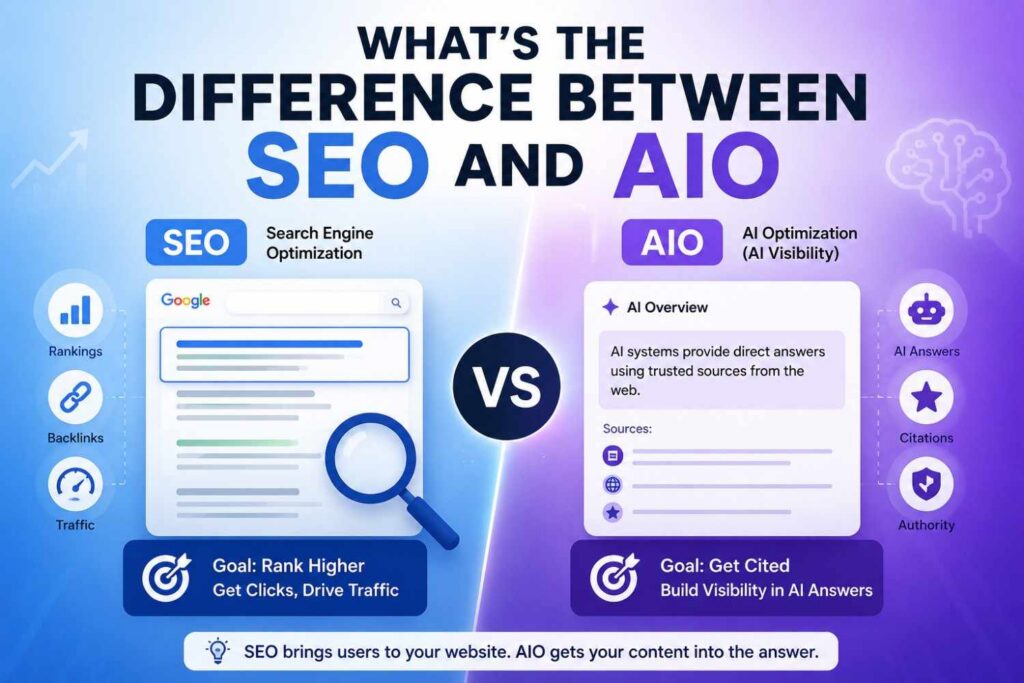
Search Engine Optimization is the practice of making your content easy for a search engine to find, understand, and rank. It’s been around for two decades and the mechanics are well understood: keyword research, on-page structure, backlinks, site speed, mobile usability, crawlability. The goal is a ranking position. The output is a spot in Google’s organic results. Success is measured in traffic, click-through rate, and where you land on the page.

None of that has gone away. It’s still the foundation everything else sits on top of.

AIO: what it actually is

AI Optimization is the practice of making your content easy for an AI system, not a ranking algorithm, to understand, trust, and cite. The targets are different: Google’s AI Overviews, ChatGPT, Perplexity, Copilot. The output is different too: instead of a ranked position, you’re aiming for a citation or a mention inside a generated answer. Success looks like showing up as a named source when someone asks an AI assistant about your topic, even if that person never clicks through to your site.

The mechanics overlap with SEO more than the acronym soup suggests, but the priorities shift. AIO leans harder on content that answers a question directly and early, clear structure an AI model can extract cleanly (think headers, bolded definitions, comparison tables), and strong authority signals, since AI systems are more conservative about which sources they’re willing to cite than a ranking algorithm is about which pages it’s willing to rank.

The concrete differences

If you’re doing traditional keyword-targeted content marketing, building backlinks, and optimizing meta tags for a target phrase, that’s SEO, and it still drives most organic traffic today. If you’re restructuring an article so an AI system can lift a clean, accurate two-sentence answer out of it and hand you the citation, that’s AIO.

A practical example: writing “best budget laptops for college students 2026” with a keyword-optimized title, internal links, and a long buyer’s guide is SEO. Adding a tight, directly-worded answer near the top of that same page, a short definition an AI model can quote cleanly, plus schema markup that explicitly labels your product comparisons, is AIO layered on top.

Measurement differs too. SEO has mature tooling: Google Search Console, rank trackers, click-through data. AIO measurement is still catching up. Right now it mostly means manually querying AI platforms about your topic and checking whether you show up, tracking referral traffic that originates from AI platforms, and monitoring brand mentions. There’s no equivalent of Search Console for “how often did ChatGPT cite me this month,” at least not yet.

Where SEO clearly still wins

If your goal is direct traffic, SEO is doing the heavier lifting, full stop. Even with AI Overviews sitting above them, organic results still appear below and still receive clicks. Being cited by an AI assistant is often a zero-click outcome. Someone gets their answer and never visits your site. That’s fine for brand awareness, but it’s not fine if your business model depends on people landing on a page, browsing products, or converting through a form.

SEO also has a much longer track record and much better tooling. You can test structured data with Google’s own Rich Results Test, watch your rankings move week to week, and attribute traffic changes to specific fixes with real confidence. AIO right now is closer to educated guesswork.

Where AIO clearly matters more

If you’re watching your organic traffic flatten or dip even though your rankings look fine, AI Overviews are very likely absorbing some of those clicks before they ever reach you. That’s not a ranking problem SEO can fix. It’s a visibility problem inside a different surface, and ignoring it means losing ground you can’t see in a rank tracker.

AIO also matters disproportionately for informational and comparison content, the exact kind of “what’s the difference between X and Y” or “best tool for Z” queries that AI assistants now answer directly instead of just linking out to. If a meaningful share of your traffic comes from those kinds of queries, being the source an AI system trusts enough to cite is worth real investment, even without a guaranteed click.

Common misconceptions, addressed directly

“AIO replaces SEO.” No. Google has explicitly said there’s no separate AI index and no special AI-Overviews-only markup. The content that earns AI citations is largely the same content that earns strong organic rankings: accurate, well-structured, backed by real authority. AIO is additive, not a replacement.

“SEO is dead because of AI search.” Also no, and this claim isn’t supported by Google’s own stated position or by current traffic data. Traditional organic results still sit on the page and still get clicked. What’s true is that the value of a top ranking has shifted somewhat, since fewer people scroll past an AI-generated answer to reach it.

“You need completely different content for AIO.” Mostly false. High-quality, clearly structured, accurate content performs well in both systems. Author credibility, internal linking, and FAQ sections help SEO and AIO alike. The real difference is emphasis, not a wholesale rewrite: put a direct, quotable answer near the top, and make sure your structured data actually matches what’s on the page.

“Schema markup guarantees an AI citation.” It doesn’t. Structured data helps AI systems interpret your content accurately, but Google has never guaranteed that correctly marked-up content will appear as a rich result or an AI citation, and the same caution applies to other AI platforms. It’s a strong signal, not a lever you can pull for guaranteed placement.

Summary

SEO and AIO aren’t rivals fighting for your attention. They’re the same underlying discipline, wearing different clothes for different surfaces. SEO gets you ranked and clicked on Google, Bing, and the search engines that still show ten blue links. AIO gets you understood and cited by the AI systems increasingly standing between your content and the person searching for it.

If your traffic depends on people landing on your page, keep SEO as the priority; it still moves more volume than anything else. If you’re losing visibility on queries an AI system now answers directly, invest in AIO on top of that foundation, not instead of it. The content that does both well looks the same either way: clear, accurate, well-structured, and honest about what it’s actually saying. Chase that, and the acronym you optimize for stops mattering as much as you’d think.

Atomic Artisans Team

August 14, 2026

SEO and AIO

aeo seo

Agencia SEO Panamá

Agency vs In-House Marketing

AI content creation

AI content tools

AI content vs human content

AI Optimization

AI Overviews

AI Search

AI search optimization

A few years ago, “search” meant typing something into Google and clicking a blue link. Now it just as often means asking ChatGPT a question and reading the answer it gives you, with maybe a couple of source links tucked underneath. That shift is why a new acronym keeps showing up next to SEO: AIO, or AI Optimization. If you write online, run a business site, or just want to understand why your traffic patterns look different than they used to, this distinction actually matters.

Here’s the honest version of what’s changed, what hasn’t, and what to do about it.

Why this matters right now

Google’s AI Overviews now sit above the traditional results on a huge share of searches, and platforms like ChatGPT, Perplexity, and Copilot answer questions directly instead of sending people to a page. Google has said publicly that the same content and structured data that ranks in normal search results is what surfaces in AI Overviews, pulled from the same index and judged by the same quality signals. That’s a meaningful data point, because it means AIO isn’t a separate system you’re gaming. It’s an extension of the same one.

But the experience for a reader has changed even if the underlying signals haven’t. Fewer people click through when an AI system already gave them the answer. That means visibility and traffic are no longer the same thing, and treating them as the same thing is where a lot of confusion starts.

SEO: what it actually is

Search Engine Optimization is the practice of making your content easy for a search engine to find, understand, and rank. It’s been around for two decades and the mechanics are well understood: keyword research, on-page structure, backlinks, site speed, mobile usability, crawlability. The goal is a ranking position. The output is a spot in Google’s organic results. Success is measured in traffic, click-through rate, and where you land on the page.

None of that has gone away. It’s still the foundation everything else sits on top of.

AIO: what it actually is

AI Optimization is the practice of making your content easy for an AI system, not a ranking algorithm, to understand, trust, and cite. The targets are different: Google’s AI Overviews, ChatGPT, Perplexity, Copilot. The output is different too: instead of a ranked position, you’re aiming for a citation or a mention inside a generated answer. Success looks like showing up as a named source when someone asks an AI assistant about your topic, even if that person never clicks through to your site.

The mechanics overlap with SEO more than the acronym soup suggests, but the priorities shift. AIO leans harder on content that answers a question directly and early, clear structure an AI model can extract cleanly (think headers, bolded definitions, comparison tables), and strong authority signals, since AI systems are more conservative about which sources they’re willing to cite than a ranking algorithm is about which pages it’s willing to rank.

The concrete differences

If you’re doing traditional keyword-targeted content marketing, building backlinks, and optimizing meta tags for a target phrase, that’s SEO, and it still drives most organic traffic today. If you’re restructuring an article so an AI system can lift a clean, accurate two-sentence answer out of it and hand you the citation, that’s AIO.

A practical example: writing “best budget laptops for college students 2026” with a keyword-optimized title, internal links, and a long buyer’s guide is SEO. Adding a tight, directly-worded answer near the top of that same page, a short definition an AI model can quote cleanly, plus schema markup that explicitly labels your product comparisons, is AIO layered on top.

Measurement differs too. SEO has mature tooling: Google Search Console, rank trackers, click-through data. AIO measurement is still catching up. Right now it mostly means manually querying AI platforms about your topic and checking whether you show up, tracking referral traffic that originates from AI platforms, and monitoring brand mentions. There’s no equivalent of Search Console for “how often did ChatGPT cite me this month,” at least not yet.

Where SEO clearly still wins

If your goal is direct traffic, SEO is doing the heavier lifting, full stop. Even with AI Overviews sitting above them, organic results still appear below and still receive clicks. Being cited by an AI assistant is often a zero-click outcome. Someone gets their answer and never visits your site. That’s fine for brand awareness, but it’s not fine if your business model depends on people landing on a page, browsing products, or converting through a form.

SEO also has a much longer track record and much better tooling. You can test structured data with Google’s own Rich Results Test, watch your rankings move week to week, and attribute traffic changes to specific fixes with real confidence. AIO right now is closer to educated guesswork.

Where AIO clearly matters more

If you’re watching your organic traffic flatten or dip even though your rankings look fine, AI Overviews are very likely absorbing some of those clicks before they ever reach you. That’s not a ranking problem SEO can fix. It’s a visibility problem inside a different surface, and ignoring it means losing ground you can’t see in a rank tracker.

AIO also matters disproportionately for informational and comparison content, the exact kind of “what’s the difference between X and Y” or “best tool for Z” queries that AI assistants now answer directly instead of just linking out to. If a meaningful share of your traffic comes from those kinds of queries, being the source an AI system trusts enough to cite is worth real investment, even without a guaranteed click.

Common misconceptions, addressed directly

“AIO replaces SEO.” No. Google has explicitly said there’s no separate AI index and no special AI-Overviews-only markup. The content that earns AI citations is largely the same content that earns strong organic rankings: accurate, well-structured, backed by real authority. AIO is additive, not a replacement.

“SEO is dead because of AI search.” Also no, and this claim isn’t supported by Google’s own stated position or by current traffic data. Traditional organic results still sit on the page and still get clicked. What’s true is that the value of a top ranking has shifted somewhat, since fewer people scroll past an AI-generated answer to reach it.

“You need completely different content for AIO.” Mostly false. High-quality, clearly structured, accurate content performs well in both systems. Author credibility, internal linking, and FAQ sections help SEO and AIO alike. The real difference is emphasis, not a wholesale rewrite: put a direct, quotable answer near the top, and make sure your structured data actually matches what’s on the page.

“Schema markup guarantees an AI citation.” It doesn’t. Structured data helps AI systems interpret your content accurately, but Google has never guaranteed that correctly marked-up content will appear as a rich result or an AI citation, and the same caution applies to other AI platforms. It’s a strong signal, not a lever you can pull for guaranteed placement.

Summary

SEO and AIO aren’t rivals fighting for your attention. They’re the same underlying discipline, wearing different clothes for different surfaces. SEO gets you ranked and clicked on Google, Bing, and the search engines that still show ten blue links. AIO gets you understood and cited by the AI systems increasingly standing between your content and the person searching for it.

If your traffic depends on people landing on your page, keep SEO as the priority; it still moves more volume than anything else. If you’re losing visibility on queries an AI system now answers directly, invest in AIO on top of that foundation, not instead of it. The content that does both well looks the same either way: clear, accurate, well-structured, and honest about what it’s actually saying. Chase that, and the acronym you optimize for stops mattering as much as you’d think.

Share this

whatsapp

Find out our more services

Is Your Business Invisible on AI Search?

Get a free audit of your website’s AI visibility, SEO health, and Google Business Profile — no strings attached.

Learn more

View Our Plans from $99/mo

Quick Fact Check

AI is expected to handle  25% of all global search queries by 2026
Businesses that optimise for AI now will have a 6–12 month head start over competitors.

Source: TheeDigital, Squarespace SEOSpace 2025

FAQ’s

Frequently Asked Questions 

atomic artisans logo
Privacy Overview

This website uses cookies so that we can provide you with the best user experience possible. Cookie information is stored in your browser and performs functions such as recognising you when you return to our website and helping our team to understand which sections of the website you find most interesting and useful.