
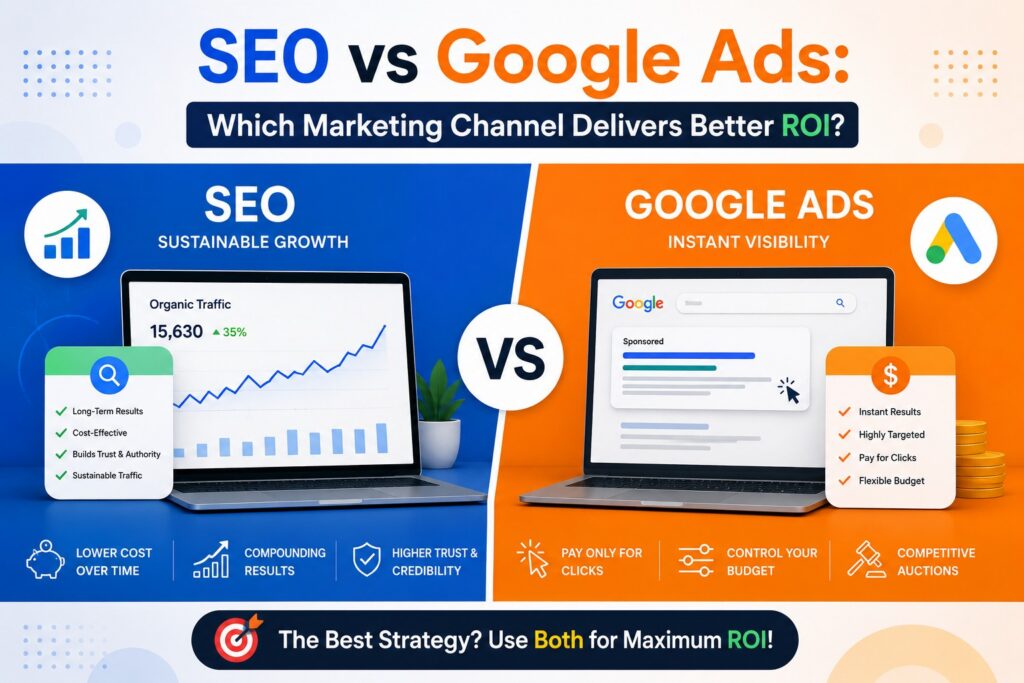

If you need customers this month, start with Google Ads. If you’re building a business you expect to run for years, start with SEO — or better, run a small Google Ads budget alongside SEO from day one so you’re not choosing between speed and durability. The two channels solve different problems, and most of the “which is better” debate misses that they’re not actually competing for the same job.
- Choose Google Ads first if: you need leads within days, you’re launching something new, or you’re in a seasonal/time-sensitive business.
- Choose SEO first if: you have a 6–12 month runway, you’re in a stable or slow-changing industry, and you want a channel that keeps producing without ongoing per-click cost.
- Best answer for most small businesses: run both — Ads for immediate flow, SEO for compounding, long-term growth.
Why This Isn’t Really an “Either/Or” Question
The comparison gets framed as a rivalry, but the two channels are built around a fundamentally different economic model:
- Google Ads: you rent visibility. Traffic starts the moment your campaign goes live and stops the moment you turn it off. You have full control over targeting and messaging, but every click has a price tag attached to it for the life of the campaign.
- SEO: you own visibility. Rankings take months to build and there’s no guarantee of a specific timeline, but once a page ranks, it keeps generating traffic without paying per visitor — and that traffic tends to compound as your site earns more authority.
That single distinction — rented traffic versus owned traffic — explains most of the practical differences business owners actually care about: cost, speed, and durability.
The Data: Cost and ROI Comparison
| Factor | Google Ads | SEO |
|---|---|---|
| Time to first results | Immediate (same day) | Typically 4–8 months for initial movement |
| Time to significant results | Immediate, but ongoing spend required | 12–18 months for strong authority in competitive niches |
| Cost when you stop | Traffic stops instantly | Traffic continues |
| Reported average ROI (2026) | Roughly 4× | Roughly 8× |
| Cost per lead | Often significantly higher, and rising | Often substantially lower once rankings mature |
Reported average marketing ROI by channel — Google Ads vs SEO, 2026.
Recent industry benchmarking puts average SEO ROI at approximately 8× compared to roughly 4× for Google Ads, with SEO cost per lead landing far below paid search once rankings are established. That gap is real, but it comes with an important caveat: Google Ads is still the better choice for businesses that need immediate leads, operate seasonally, or compete in markets where purchase intent is urgent.
It’s also worth noting that SEO timelines have generally stretched in recent years due to increased competition and more sophisticated search algorithms, with 4–8 months now typical for initial results and 12–18 months for meaningful authority in competitive niches — so “SEO takes time” isn’t a caveat, it’s the whole point of the channel.
Atomic Artisans Insight: The Real Question Isn’t Which Channel — It’s What You Can’t Afford to Get Wrong
We’ve watched small business owners lose money on both sides of this decision, and it’s rarely because they picked the “wrong” channel. It’s because they picked a channel that didn’t match their actual constraint.
If your business will run out of cash before SEO has time to work, SEO is the wrong first move regardless of its long-term ROI you won’t survive long enough to benefit from it. Conversely, if you’re already stable and simply reinvesting profit into growth, funding a Google Ads account you can’t sustain past three months just buys you a temporary traffic spike with no lasting asset behind it.
Before picking a channel, answer one question honestly: how many months of runway do you have before you need revenue from this specific investment? Under 3 months, lean paid. Over 6 months, lean SEO, with paid as a supplement.
When to Run Both Together
For most established small businesses, this isn’t actually a sequencing question it’s a resourcing question. A common, effective structure:
- Run Google Ads on your highest-intent, most profitable keywords while SEO is still building. This funds lead flow during the months where organic traffic is minimal.
- Use Google Ads conversion data to prioritize your SEO content. Ads reveal, in real dollars, which keywords and offers actually convert — take the guesswork out of what content to build next.
- Gradually shift budget from Ads to SEO for keywords where you’ve earned strong organic rankings, and redirect that Ads budget toward keywords or seasonal pushes where you still need paid visibility.
- Use retargeting on visitors who found you through organic search but didn’t convert — this spends ad budget on traffic your content already earned, which tends to be some of the cheapest, highest-converting spend available.
This hybrid approach is increasingly the default recommendation across the industry, not a compromise position — running Google Ads during the SEO build-up period to generate leads while organic rankings take hold, then gradually reducing ad spend as organic traffic grows, is a standard playbook.
How AI Search Changes the Calculation
One shift worth factoring into your decision: roughly half of all Google searches now include an AI-generated overview, and about half of consumers use AI-powered search. This is compressing some traditional organic clicks — but it isn’t neutral for both channels. Search visibility, brand mentions, and well-structured, authoritative content increasingly influence whether AI tools recommend a business at all, which makes strong SEO fundamentals (helpful content, clear structure, real expertise) more valuable, not less, even as raw click volume shifts. Google Ads, by contrast, still functions largely as it always has: pay for placement, get placement.
For more on how this affects content strategy specifically, see our guide on how much a business should spend on digital marketing each month, which covers how to split a budget across channels including SEO and paid search.
Common Mistakes We See
- Judging SEO on a 30-day timeline. SEO is structurally a 4+ month channel; judging it against Google Ads’ immediacy is comparing the wrong things.
- Turning off Google Ads and expecting SEO to instantly fill the gap. These traffic sources rarely transition cleanly — plan for an overlap period, not a hard switch.
- Ignoring Google Ads conversion data when planning SEO content. This is free market research most businesses already have and don’t use.
- Spending on Ads with no landing page strategy. According to Google’s own guidance, ad relevance and landing page experience directly affect both cost and results — a strong campaign with a weak landing page underperforms regardless of budget.
Next Step
Not sure which channel fits your timeline and budget? Talk to our team for a free assessment of where your business stands, or explore our SEO and paid search services to see how we structure hybrid strategies for businesses at different growth stages.
