

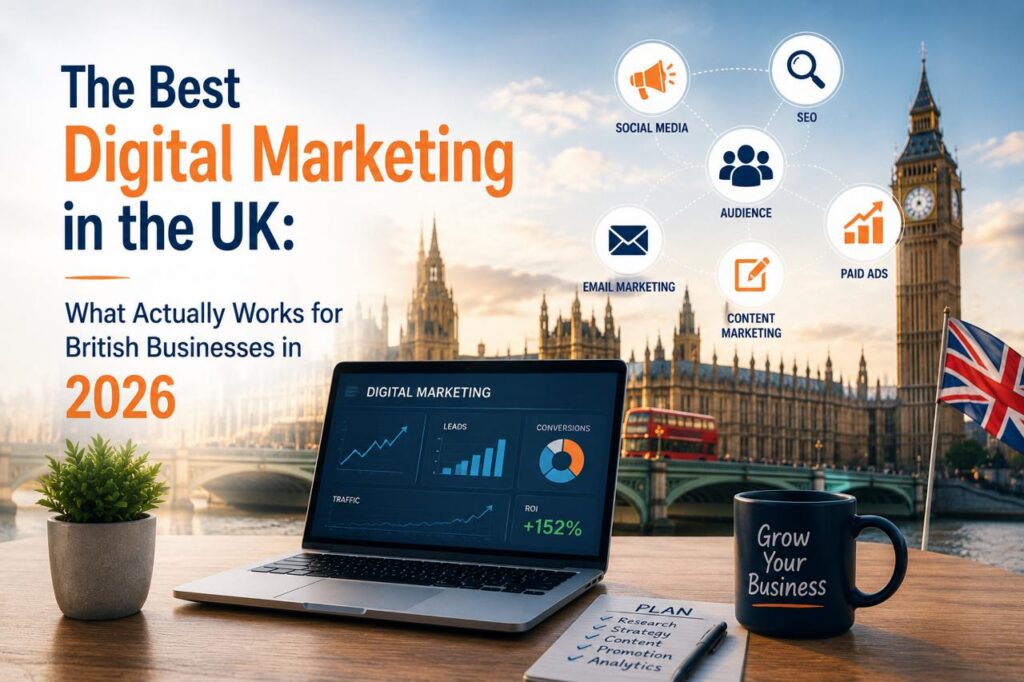
The best digital marketing for UK businesses in 2026 combines SEO, Google Ads, and content marketing. SEO builds long-term organic traffic, Google Ads captures immediate demand, and content compounds over time. Most UK businesses see the best ROI by starting with local SEO and Google Ads, then scaling into content and email marketing.
Key Takeaways
- UK digital ad spend hit £18.7bn in H1 2025
- SEO is used by 77% of UK businesses
- Local SEO drives 46% of all Google searches
- Email marketing delivers ~£36 ROI per £1 spent
- The best strategy combines SEO + Paid Ads + Content
The UK Digital Marketing Landscape in 2026 (The Real Numbers)
Before diving into tactics, it’s worth understanding the size of what we’re dealing with.
The UK is the third-largest digital advertising market in the world, sitting behind only the US and China. In the first half of 2025 alone, UK digital ad spend hit £18.7 billion — and that number is still climbing. UK SMEs increased their digital marketing budgets by 19% in 2025, which tells you something important: small businesses are no longer treating digital marketing as optional.
A few other stats worth knowing:
- 77% of UK businesses now invest in SEO — it’s one of the most widely used channels in the country
- Local SEO drives 46% of all Google searches in the UK — huge for any business with a physical presence or regional focus
- 76% of UK marketers say marketing has become harder over the past 12 months
- 56% feel overwhelmed by the pace of change in the industry
That last point is the one that matters most for this blog. There is a lot going on right now. AI, short-form video, algorithm changes, rising ad costs — it’s a lot to keep up with. The businesses that are winning are the ones that have a clear strategy and aren’t just chasing every new trend.
What Does “Best Digital Marketing” Actually Mean for a UK Business?
Good question — and honestly, it depends on three things:
- Where your customers are — are they searching on Google, scrolling Instagram, checking email, or all three?
- What stage of the journey they’re at — do they already know they need what you offer, or do they need to discover you first?
- What your budget allows — not every channel suits every budget, and spreading yourself too thin is as bad as doing nothing
With that framing in mind, here are the channels that are delivering real results across the UK market right now.
1. SEO — Still the Backbone of UK Digital Marketing
If you want sustainable, compounding visibility online, SEO is still the most cost-effective long-term investment you can make.
The reason 77% of UK businesses invest in it is simple: people search for things on Google before they buy them. Getting on page one means capturing that intent at the exact moment someone is ready to act.
But SEO in 2026 isn’t just about keywords. It’s about:
- Technical health — fast load times, mobile responsiveness, clean site architecture
- Content that genuinely helps — not just keyword-stuffed pages, but content that answers real questions
- Authority building — SEO backlinks from credible UK-relevant sites that tell Google your website can be trusted
- Local presence — for businesses operating in specific cities, local SEO is arguably more important than broad national rankings
The companies that treat SEO as a quick win tend to be disappointed. The ones who commit to it as a 6–12 month investment consistently see traffic and leads growing month after month without paying for every click.
If you’re based in a major UK city, local search competition is particularly fierce right now. Whether you need SEO in London, Manchester, Birmingham, Sheffield, Glasgow, or Kent — the fundamentals are the same, but local authority signals matter enormously in each market.
2. Google Ads — For Capturing Demand That Already Exists
The average cost-per-click on Google Search in the UK now sits at around £1.48 — up from £1.22 two years ago. That means ads are getting more expensive, and wasted spend is a real risk if campaigns aren’t managed properly.
But for the right kind of business, Google Ads remain one of the fastest ways to generate leads in the UK. The logic is simple: you show up at the exact moment someone searches for what you sell. Unlike social ads, you’re not interrupting anyone — they came to Google because they want something.
Google Ads work best when:
- Your service is something people actively search for (trades, professional services, healthcare, legal)
- You need leads quickly while your organic SEO builds
- You’re targeting a specific UK city or region
- You have a properly built landing page that converts the traffic you’re paying for
The biggest mistake UK businesses make with Google Ads? Running them without proper tracking, keyword match types, or negative keyword lists — and wondering why the budget disappears without results. A properly managed ads management service more than pays for itself by preventing this.
3. Meta Ads — For Building Awareness and Reaching New Audiences
The UK has 54.8 million social media users — that’s 79% of the entire population. Facebook still leads UK social web traffic with a 69% share, and Instagram continues to grow among 18–45 year olds.
Meta Ads work differently from Google. You’re not catching people mid-search — you’re reaching people who match your ideal customer profile while they’re scrolling. That means your creative has to work hard, but the targeting capabilities are genuinely impressive.
What makes Meta work well for UK businesses:
- Retargeting website visitors who didn’t convert the first time
- Reaching lookalike audiences based on your existing customers
- Running offers, promotions, or awareness campaigns with strong visual creative
- UGC-style videos that feel native to the platform and outperform polished brand content
The businesses getting the best results on Meta right now aren’t the ones with the biggest budgets — they’re the ones with the most compelling creative and a clear offer.
4. Social Media Marketing — Organic Presence Still Matters
There’s a tendency to think organic social media is dead unless you’re paying. It’s not.
84% of UK businesses include organic social media in their marketing strategy — more than any other channel. That’s because consistent social presence builds trust over time, keeps your brand visible between ad campaigns, and creates a community around your business.
The key difference between businesses that get results from social media and those that don’t comes down to strategy. Posting randomly for the sake of it doesn’t move the needle. A proper social media marketing strategy — with clear content pillars, consistent posting, engagement habits, and platform-specific content — does.
If you’re trying to grow an audience from scratch, a dedicated social media growth strategy that’s built around your specific audience and goals will get you there faster than trial and error.
According to Sprout Social’s UK insights, the best times to post and the most engaging content formats vary significantly by platform and audience — generic advice rarely applies.
5. Content Marketing and Blog Writing — The Long Game That Compounds
Here’s something that doesn’t get talked about enough.
A well-written blog post that ranks on Google doesn’t just bring traffic once. It can bring in organic visitors every single month for years — without any ongoing spend. Multiply that across 20, 30, 50 optimised posts, and you’ve built a lead-generation machine that runs in the background 24/7.
Professional blog writing that combines strong SEO fundamentals with genuinely useful content is one of the highest-return investments in digital marketing. The caveat: it takes time, and it requires real expertise to produce content that ranks and converts — not just content that fills space.
Think of every quality blog post as a salesperson that never takes a day off.
6. Email Marketing — The Most Underrated Channel in the UK
Everyone assumes email is old-fashioned. The data says otherwise.
Email marketing consistently delivers some of the highest ROI of any digital channel — often cited around £36 return for every £1 spent. In the UK, where privacy regulations (GDPR) have forced businesses to build more intentional email lists, the people on your list are often your most engaged, highest-converting audience.
Email marketing done well isn’t just newsletters. It’s welcome sequences, abandoned cart flows, re-engagement campaigns, and post-purchase nurturing. The businesses ignoring it are leaving money on the table.
7. Website — Where All of It Either Lives or Dies
This is the one people forget when they’re chasing tactics.
You can run the best Google Ads campaign in the country, rank on page one for your target keywords, and build a massive social following — and still get a terrible return if your website is slow, confusing, or doesn’t give people a clear reason to act.
Your website isn’t just a brochure. It’s the hub of your entire digital marketing operation. Everything else drives traffic to it. And if it’s not converting that traffic, all your other marketing spend is being wasted.
A properly built website with strong UI/UX design — fast, mobile-optimised, clear in its messaging, with prominent calls to action — is the foundation everything else sits on. Get this wrong and the rest doesn’t matter.
What the Best Digital Marketing Actually Looks Like in Practice
The businesses that consistently outperform their competitors in the UK digital market aren’t doing one thing really well. They’re doing several things competently, in a joined-up way, with a clear understanding of how each channel feeds the others.
Here’s what that typically looks like:
- Strong website foundation — fast, mobile-friendly, conversion-optimised
- SEO building organic visibility — local and national, depending on the business
- Google Ads capturing immediate demand — managed tightly to avoid wasted spend
- Meta Ads building awareness and retargeting — fuelled by strong visual creative
- Content and blog posts compounding — answering the questions their customers are already Googling
- Email marketing nurturing leads — turning enquiries into customers, customers into repeat buyers
- Social media maintaining visibility — building trust and community between campaigns
None of these is optional. But they don’t all need to be running at full capacity at the same time. The art of good digital marketing is knowing which lever to pull first given your goals, your budget, and where you are right now.
That’s what a genuine digital marketing partner helps you figure out — as opposed to an agency that just sells you the service they’re best at, regardless of whether it’s right for you.
How to Choose a Digital Marketing Agency in the UK
A quick word on this, because the market is crowded.
There are hundreds of digital marketing agencies in the UK. Some are excellent. Some are average. A few are genuinely not worth your money.
When you’re evaluating an agency, look for:
- Transparency on results — can they show you real case studies with real numbers?
- A clear process — do they explain how they’ll deliver results, not just that they will?
- Honest conversations about timeline — anyone promising page one in 30 days is either misleading you or planning something that’ll hurt your site long-term
- Integrated thinking — do they understand how SEO, ads, content, and social work together, or are they siloed in one channel?
- Communication — you should hear from your agency regularly, not just when you chase them
The best agencies treat your budget like it’s their own money. They ask hard questions before recommending anything. And they’re comfortable telling you when something isn’t working.
