

Let me be straight with you.
There’s no universal right answer here. Anyone who tells you “just use Google Ads” or “Meta is better for small businesses” without knowing anything about your business is guessing. Or selling something.
What I can tell you is this: Google Ads and Meta Ads work in completely different ways, attract people at completely different stages of the buying journey, and suit completely different types of businesses.
Once you understand that, the decision gets a lot easier.
The One Thing You Need to Understand First
Think about the last time you searched “plumber near me” or “accountant in Birmingham.”
You weren’t browsing. You needed something. You had your wallet metaphorically in hand.
Now think about the last time you were scrolling through Facebook or Instagram and an ad caught your eye. You weren’t looking for anything. But the ad was interesting enough to stop you mid-scroll.
That’s the entire difference between Google Ads and Meta Ads in a nutshell.
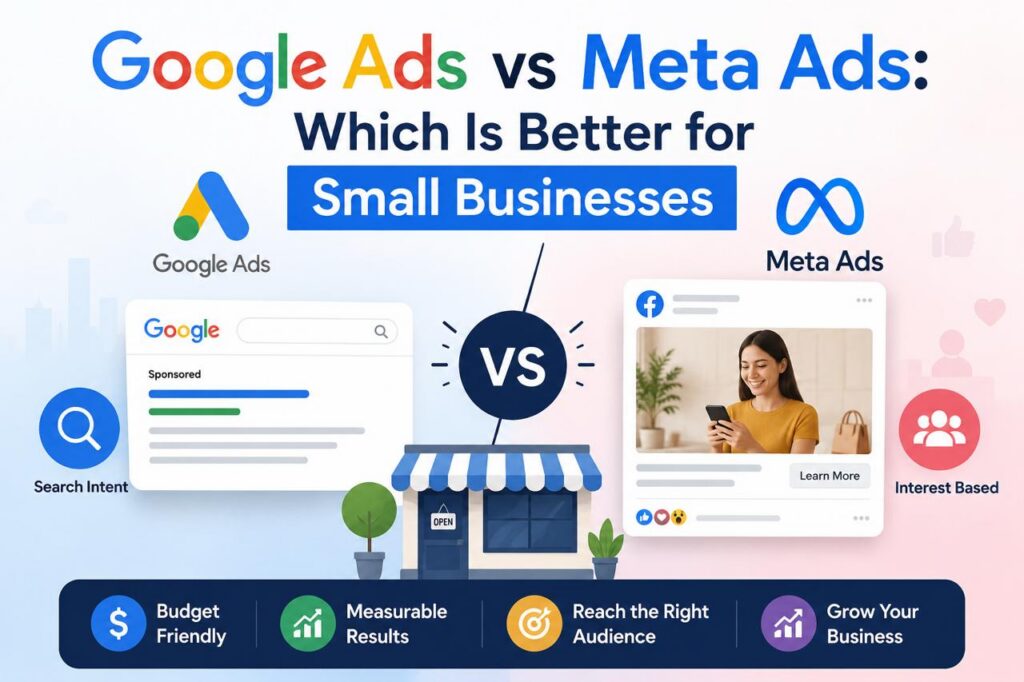
- Google Ads — you show up when someone is already searching for what you sell.
- Meta Ads — you show up in front of the right type of person, even when they’re not looking.
Neither is better. They just do different things.
So, What Is Google Ads Actually Good At?
Google Ads is intent-based advertising. You bid on keywords, and when someone types that keyword into Google, your ad can appear at the top of the results.
For certain businesses especially local service businesses this is incredibly powerful. A dentist, a solicitor, an emergency electrician. These are all services people search for right now because they need them right now.
If that sounds like your business, Google Ads is probably your best friend.
A few situations where Google tends to work really well:
- You run a local service business trades, healthcare, legal, financial
- People already know they need what you offer and are actively looking
- You want quick leads while your organic SEO is still building momentum
- You’re targeting a specific town or city it pairs naturally with local SEO too
The downside? It can get expensive in competitive industries. Legal, finance, insurance CPCs can reach £20-30+ in some cases. But in less crowded niches, you can get solid leads for a few pounds per click.
According to WordStream’s industry benchmarks, average conversion rates across Google Ads campaigns sit around 3–4% but well-run campaigns often outperform this significantly.
The other thing worth remembering: the moment you stop paying, the traffic stops. That’s why pairing paid ads with a long-term SEO strategy is always the smarter play.
What Does Meta Ads Do Differently?
Meta Ads that’s Facebook and Instagram work on a completely different logic. You’re not catching people mid-search. You’re putting your brand in front of people who look like your ideal customer.
Meta knows an extraordinary amount about its users. Age, location, interests, buying behaviour, life events. You can target new parents, homeowners, fitness enthusiasts, small business owners — the list goes on.
The upside? You can reach people who’ve never heard of you but are highly likely to be interested. The downside? They weren’t looking for you five seconds ago, so your creative has to work hard to stop the scroll and make them care.
Meta tends to work best when:
- You’re building awareness for a new product, service, or brand
- Your offering is visual — food, fashion, interiors, fitness, beauty
- You want to retarget people who visited your website but didn’t convert
- You’re directing people to a properly built landing page with a clear offer
- You want to grow your audience on social media at the same time
CPCs on Meta are typically lower than Google — often £0.30 to £1.50 in many niches. But a lower click cost doesn’t automatically mean better ROI. The intent isn’t as strong, so your ad, your offer, and your landing page all need to pull their weight.
HubSpot’s advertising data puts average Facebook Ads CTR at around 0.9% — which sounds small until you remember you’re reaching people who weren’t looking at all.
A Straight Comparison
| Google Ads | Meta Ads | |
| Who you reach | People actively searching | People who match your audience |
| User mindset | “I need this now” | “Oh, that looks interesting” |
| Best format | Text (search ads) | Images and video |
| Average CPC | £1–£10+ | £0.30–£1.50 |
| Time to results | Days | 2–4 weeks |
| Retargeting | Yes (Display Network) | Yes — and very good at it |
| Works best for | Local services, high-intent niches | Visual brands, awareness, retargeting |
Honestly — Should You Pick One or Use Both?
If budget is tight, pick the one that fits your goal right now.
Launching a service people are already Googling? Start with Google Ads. Building a brand where visual storytelling matters? Start with Meta Ads.
But if you can swing it, running both is genuinely more powerful than the sum of its parts. Google captures the people already searching. Meta builds awareness with everyone else. Over time, you start seeing people convert on Google who first discovered you on Instagram. That cross-channel effect is real, and it compounds.
The businesses that tend to grow fastest are the ones treating ads as part of a wider system — not a standalone fix. That means strong landing pages, an email marketing sequence that nurtures leads, a social media presence that builds trust, and SEO quietly working in the background so you’re not dependent on ad spend forever.
If you’re based in the UK, that organic layer matters even more. Whether you’re in London, Manchester, Birmingham, Sheffield, Glasgow, or Kent local search visibility is often the most cost-effective long-term play alongside paid.
A proper ads management service can run both platforms in a joined-up way, so neither budget is wasted. Pair that with a social media growth strategy, UGC videos, SEO backlinks, and a well-built website with solid UI/UX design — and you stop relying on any single channel to carry everything.
Before You Spend a Penny — Get the Basics Right
This is the part most people skip.
Paid ads don’t fix a broken funnel. If your website is slow, your landing page is confusing, or there’s no follow-up after someone enquires — ads will just accelerate the problem.
Before scaling budget on either platform, check:
- Is your website fast and mobile-friendly?
- Does your landing page have a single, clear call to action?
- Are you capturing leads so you can follow up, not just hoping they call?
- Do you have blog content building trust and organic visibility?
Get those things in order first. Then the ads actually have something to land on.
