
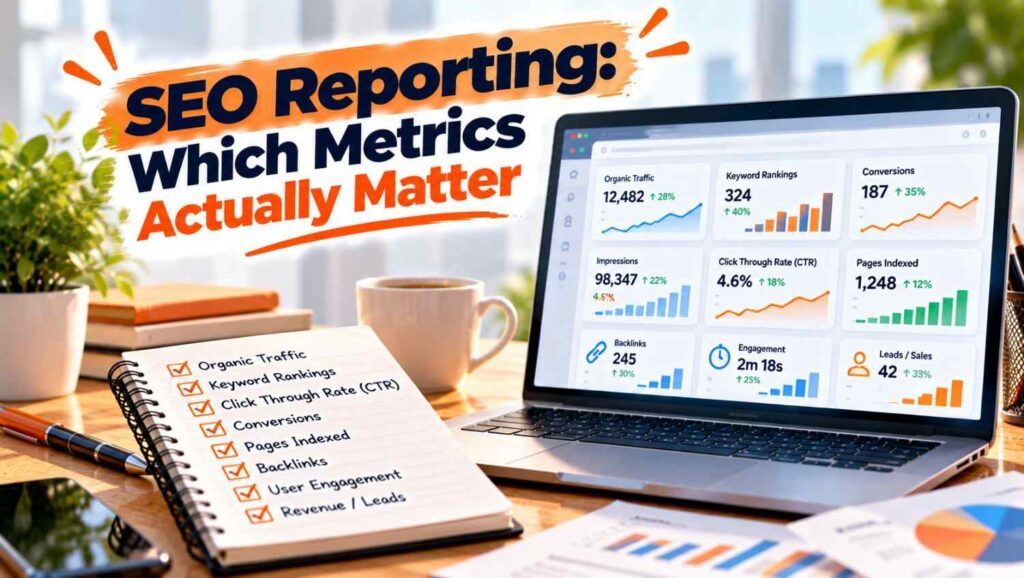

The SEO reporting metrics that matter most are the ones tied to business results: leads or sales from organic search, organic traffic to key pages, impressions and clicks from Search Console, and rankings for relevant searches. Report them monthly against a goal, and treat scores such as domain authority as context, not proof.
- Good SEO reporting metrics start with leads, sales or enquiries from organic search, because rankings and traffic only matter if they lead there
- Google Search Console gives you impressions, clicks, click through rate and average position for free
- Google Analytics key events show which visits led to an action that matters to your business
- Third party scores such as domain authority are calculated differently by each tool, so do not compare them across tools
- A number one ranking for a search that never converts adds little value
- Report monthly, compare against the same period, and explain what you will do next
Table of Contents
Why SEO reporting metrics should start with business goals
Our guide to picking the right SEO agency says to look for measurable results, and the same applies if you track SEO yourself. Conductor, an SEO software vendor, puts revenue and ROI first and treats conversions as a fallback when revenue data is not available. It also warns that conversions are not ROI unless you value them with real data.
Embryo, a Manchester agency, says to align KPIs with business goals. Both are sellers of SEO products or services, so treat their lists as sensible practice rather than proof. The principle is simple: choose SEO reporting metrics that answer the question your boss or client actually asks, which is usually whether SEO is bringing in business.
The seven SEO reporting metrics that matter
Our post on what SEO is and how it works explains the chain from visibility to action, and these seven SEO reporting metrics follow that chain.
1. Leads and sales from organic search
Google explains in its key events help page that a key event measures an action that matters to your business, and that any collected event can become one. Mark form submissions, calls or purchases as key events, then report how many came from organic search.
2. Organic traffic to key pages
Count visitors arriving from organic search, but look at the pages that matter, such as service and product pages, not only the site total. Conductor suggests segmenting by landing page, device and location, and excluding branded traffic unless you run a brand campaign, because most sites rank for their own name.
3. Impressions and clicks
Google’s Search Console performance report shows clicks, impressions, click through rate and average position, with tabs for queries, pages, countries and devices. Impressions show how often you appeared, and clicks show how often people chose you.
4. Click through rate
Click through rate is clicks divided by impressions. A page with many impressions and few clicks may need a better title or description. Embryo makes the same point: high impressions do not guarantee traffic, which is why this ratio helps explain the gap.
5. Rankings for relevant searches
Google defines average position as the average rank of your topmost result. It is averaged across queries, so a single number can hide movement. Conductor suggests grouping rankings by theme and tracking how many queries sit in the top 3, top 10 and beyond. Track searches a customer would actually use.
6. Indexing and page experience
Our post on why rankings suddenly drop shows how a technical fault can undo months of work. Add indexing to your SEO reporting metrics by checking how many key pages are indexed and whether Core Web Vitals pass. Embryo and Conductor both list indexed pages and website health among their KPIs.
7. Links earned
Report new referring domains and whether they are relevant, not just the total. Conductor and Embryo both include backlinks, though Embryo notes many tools do not track them well. Quality and relevance matter more than the count.
SEO reporting metrics that mislead
Our guide to local SEO covers the signals behind map results, and some popular numbers say less than they seem to. Conductor warns that a number one ranking for a query that drives non converting traffic adds little value, and that visibility scores should not be compared across tools because each calculates them differently.
Domain authority is a third party score that only indirectly reflects factors like links. Bounce rate, traffic and impressions can all rise without a single extra enquiry. Google’s own report guidance says to aim for meaningful impressions, not just more.
How to build a simple monthly report
Our Local SEO Kent guide mentions monthly reporting through a live dashboard, and a simple set of SEO reporting metrics works for most small sites. Pull clicks and impressions from Search Console, conversions from Google Analytics, and a short list of tracked searches.
Embryo suggests weekly or monthly reporting, with daily monitoring only if needed. Compare each month with the previous one and with the same month last year, because seasonality can distort a short comparison. That comparison advice is our own judgement. Add two lines on what changed and what you will do next. Our guide to how long SEO takes explains why early months may show impressions before clicks.
What good SEO reporting metrics look like from an agency
Our SEO services include plain English reporting tied to enquiries. Ask any provider to show leads, not only rankings, to explain changes in simple terms, and to list the next actions. A report that is all charts and no conclusions is a warning sign.
Examples
These are illustrative scenarios rather than client case studies, but they show how SEO reporting metrics tend to be used.
A dentist saw impressions rise for months with few extra clicks. Rewriting titles to match what patients searched for improved click through rate.
A shop celebrated a number one ranking for a broad term. Search Console showed almost no clicks to the product pages, so it shifted effort to more specific searches that led to sales.
A consultant tracked every metric available. Cutting the report to leads, organic traffic to service pages, clicks and tracked rankings made it easier to act on.
Ready to track what matters
Clear SEO reporting metrics turn SEO from a cost into a decision. At Atomic Artisans we report on enquiries, clicks and rankings through our SEO services. Take a look at our pricing, book a call with our team, or get in touch through our contact page to get started.
