

If you’ve recently invested in SEO, there’s one question you’re probably asking almost immediately:
“How long does SEO take to work?”
The honest answer? SEO is not instant. But when done properly, it becomes one of the most powerful long-term marketing channels for sustainable traffic, leads, and sales.
Some businesses start seeing early improvements within a few weeks, while competitive industries may take several months before meaningful rankings appear. The timeline depends on multiple factors — your website’s current condition, competition level, content quality, backlinks, and the SEO strategy being implemented.
In this guide, we’ll break down:
- How long SEO usually takes
- What impacts SEO results
- Why some websites rank faster than others
- What realistic SEO growth looks like in 2026
- Common mistakes that slow rankings down
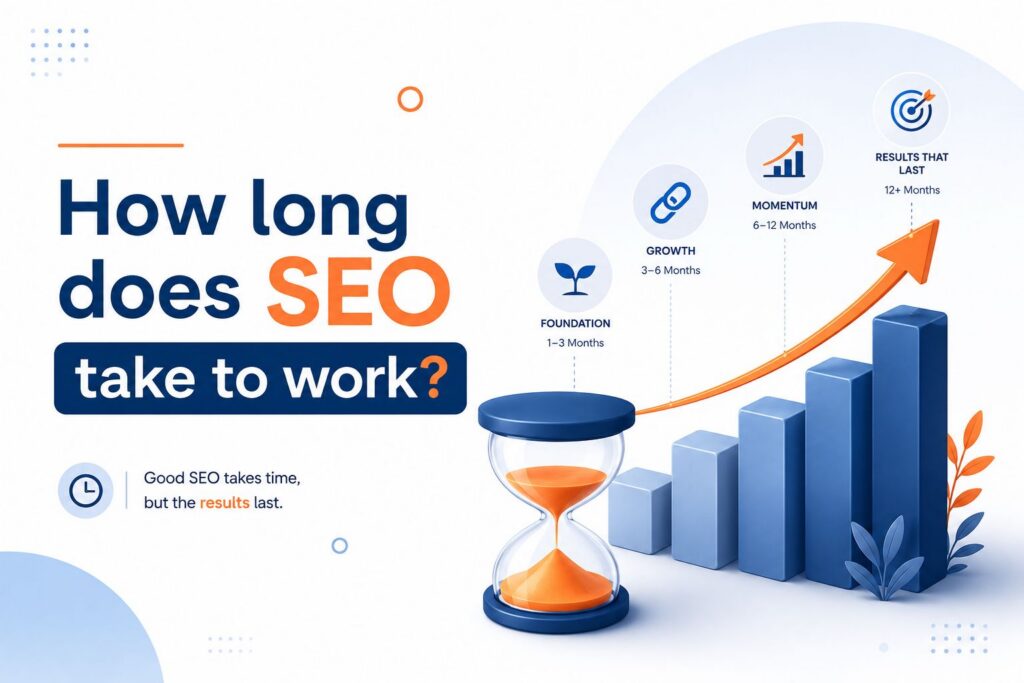
The Short Answer: SEO Usually Takes 3–6 Months
For most businesses, SEO starts showing measurable movement within:
- 1–3 months: Technical improvements and indexing
- 3–6 months: Keyword ranking growth and traffic increases
- 6–12 months: Significant organic traffic and lead generation
- 12+ months: Compounding long-term growth
SEO is a long-term investment, not a quick hack.
Google needs time to:
- Crawl your website
- Understand your content
- Evaluate trust signals
- Compare you against competitors
- Test how users interact with your pages
This is why businesses that stay consistent with SEO almost always outperform businesses looking for overnight results.
What Impacts How Fast SEO Works?
Not every website ranks at the same speed. Several factors influence your SEO timeline.
1. Website Age and Authority
Older websites with existing authority generally rank faster than brand-new domains.
If your site already has:
- Existing backlinks
- Indexed pages
- Domain authority
- Historical trust with Google
…you’ll usually see results faster.
New websites often need more time because Google has less trust data available.
2. Competition Level
Ranking for:
- “Plumber in Sheffield”
is much easier than: - “Best SEO agency UK”
Highly competitive keywords take longer because you’re competing against established websites with years of authority and backlinks.
This is why proper keyword clustering and targeting matter so much.
Instead of targeting only broad terms, smart SEO strategies focus on:
- Long-tail keywords
- Search intent
- Topic authority
- Supporting content clusters
3. Technical SEO Health
A slow or poorly structured website can delay SEO growth significantly.
Common technical SEO issues include:
- Slow page speed
- Broken internal links
- Poor mobile responsiveness
- Duplicate content
- Indexing errors
- Weak site structure
Google prioritises websites that provide a good user experience.
You can test your website performance using:
4. Content Quality
This is where many businesses struggle.
Publishing generic AI-generated blogs every week will not magically improve rankings.
Google increasingly rewards content that demonstrates:
- Experience
- Expertise
- Authority
- Trustworthiness (E-E-A-T)
Strong SEO content should:
- Answer specific search queries
- Include useful examples
- Match search intent
- Be easy to scan and read
- Include proper headings and structure
- Offer real value to readers
A well-written 1,500-word article often outperforms ten weak blogs.
For content best practices, Google’s official Helpful Content documentation is worth reading:
5. Backlinks and Authority Signals
Backlinks remain one of Google’s strongest ranking signals.
When trusted websites link to your content, Google sees this as a vote of confidence.
However, quality matters far more than quantity.
A few strong backlinks from reputable websites are usually more valuable than hundreds of spammy directory links.
High-authority resources discussing backlinks include:
- Ahrefs Link Building Guide
- Moz Beginner’s Guide to SEO
Realistic SEO Timeline Breakdown
Month 1: SEO Foundation Setup
During the first month, most SEO work happens behind the scenes.
This usually includes:
- Technical SEO audit
- Keyword research
- Competitor analysis
- On-page optimisation
- Internal linking improvements
- Google Search Console setup
- Content planning
At this stage, rankings may not move much yet.
Months 2–3: Early Keyword Movement
This is where websites often begin seeing:
- New keywords indexing
- Small ranking improvements
- Increased impressions in Google Search Console
- Better crawl activity
Traffic increases may still be modest, but momentum starts building.
Months 4–6: Organic Traffic Growth
For many businesses, this is where SEO starts becoming measurable.
You may notice:
- Higher keyword rankings
- Increased organic traffic
- More enquiries and leads
- Improved local visibility
- Better conversion rates
Businesses with strong local SEO often see faster results than national campaigns.
6–12 Months: Compounding SEO Results
This is where SEO becomes extremely valuable.
By this stage, your website has usually built:
- More authority
- More indexed content
- Stronger backlink profiles
- Better topical relevance
Traffic often compounds month after month without increasing ad spend.
This is the major advantage SEO has over paid advertising.
Common SEO Mistakes That Slow Results Down
1. Targeting Extremely Competitive Keywords Too Early
Trying to rank immediately for massive keywords usually leads to frustration.
Start with realistic opportunities first.
2. Publishing Thin Content
Short, generic blogs rarely perform well anymore.
Depth, clarity, and usefulness matter much more.
3. Ignoring Internal Linking
Internal links help Google understand your site structure and distribute authority across pages.
4. Expecting Immediate Results
SEO is not Google Ads.
It’s a long-term visibility strategy that compounds over time.
5. Buying Spam Backlinks
Cheap backlinks may temporarily boost rankings but often lead to long-term penalties.
Quality always wins.
How to Speed Up SEO Results
While SEO naturally takes time, there are ways to accelerate progress:
Focus on:
- Long-tail keyword opportunities
- Local SEO optimisation
- High-quality blog content
- Strong internal linking
- Technical performance improvements
- Consistent publishing schedules
- High-authority backlinks
Businesses that combine all these elements usually see results much faster than businesses relying on only one tactic.
Final Thoughts
So, how long does SEO take to work?
For most businesses, meaningful SEO growth happens between 3–6 months, with the strongest long-term gains appearing after 6–12 months of consistent work.
SEO rewards patience, consistency, and quality.
The businesses that win in search are rarely the ones looking for shortcuts. They’re the ones building authority steadily through strong technical foundations, useful content, and trustworthy signals over time.
If you approach SEO as a long-term business asset rather than a quick fix, it can become one of the highest-ROI marketing investments you make.
