

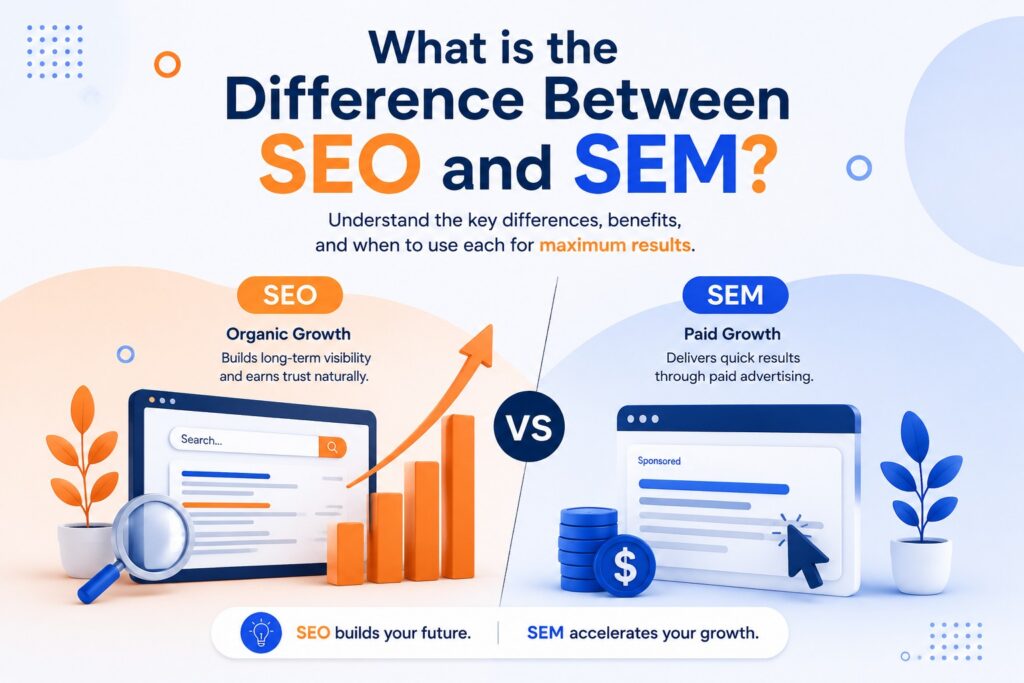
If you’ve ever searched for ways to grow your business online, you’ve likely come across two terms that seem almost interchangeable — SEO and SEM. But they’re not the same thing. Understanding the difference can save you thousands of dollars and help you invest your marketing budget where it truly counts.
Let’s break it down — simply, clearly, and without the jargon overload.
What is SEO (Search Engine Optimization)?
SEO is the practice of optimizing your website so it ranks organically (without paying) on search engines like Google and Bing. When done right, SEO drives consistent, long-term traffic to your site — for free.
A professional SEO company focuses on three core pillars:
- On-Page SEO – Optimizing content, headings, meta tags, and keyword usage on each page
- Off-Page SEO – Building backlinks and brand authority across the web
- Technical SEO – Improving site speed, mobile-friendliness, crawlability, and structured data
Key Characteristics of SEO:
- Results take time (typically 3–6 months to see significant movement)
- Traffic is free once you rank
- Builds long-term brand authority
- Requires ongoing content and link-building efforts
Learn more: Google’s Official SEO Starter Guide — one of the most trusted resources for understanding how search ranking works.
What is SEM (Search Engine Marketing)?
SEM is a broader umbrella term that covers paid strategies to appear on search engine results pages (SERPs). The most common form is PPC (Pay-Per-Click) advertising — think Google Ads or Bing Ads.
With SEM, you bid on keywords and your ad appears at the top of the results immediately. The moment you stop paying, the traffic stops too.
Key Characteristics of SEM:
- Results are instant — your ad goes live in hours
- You pay for every click
- Great for product launches, seasonal campaigns, and quick wins
- Requires a consistent budget to maintain visibility
Explore further: Google Ads Help Center — the go-to resource for setting up and managing paid search campaigns.
SEO vs SEM: Side-by-Side Comparison
| Feature | SEO | SEM |
| Cost | Time & effort (organic) | Pay-per-click (budget required) |
| Speed | Slow (months) | Fast (hours to days) |
| Sustainability | Long-term | Stops when budget stops |
| Trust Factor | Higher (users trust organic) | Lower (marked as “Ad”) |
| Best For | Brand building, long-term ROI | Quick traffic, promotions |
| Click-Through Rate | Generally higher | Lower (ad fatigue) |
Does SEO Fall Under SEM?
Technically, yes — in the traditional marketing definition, SEM includes both paid and organic search strategies. But in modern digital marketing usage, most professionals use SEM to mean paid search and SEO to mean organic search. This article follows that practical convention.
Reference: Moz’s Beginner’s Guide to SEO — a comprehensive, industry-trusted resource explaining organic search from the ground up.
Which One Does Your Business Actually Need?
The honest answer? Most businesses need both — but at different stages.
Start with SEO if you:
- Are building a long-term online presence
- Have a limited monthly ad budget
- Want to create content that compounds in value over time
- Are in a competitive industry where paid ads are expensive
Start with SEM if you:
- Need leads or sales right now
- Are launching a new product or service
- Have a clear budget for paid advertising
- Want to test which keywords convert before committing to SEO
Use Both When:
- You want to dominate the SERP for high-value keywords
- Your organic rankings are growing but you need to fill the gap with paid traffic
- You’re running time-sensitive promotions alongside evergreen content
Partnering with a search engine optimization agency that also understands paid media gives you a unified strategy — not a siloed approach.
Related read on our blog: How to Choose the Right SEO Strategy for Your Business
Why Work with a Professional SEO Company?
Many businesses try to handle SEO in-house — and quickly realize it’s a full-time job. A dedicated SEO service agency brings:
- Expertise across algorithm updates – Google updates its algorithm thousands of times per year. Agencies stay ahead of changes so you don’t have to.
- Proven tools and audits – Access to platforms like Ahrefs, SEMrush, and Screaming Frog for deep-dive analysis
- Content strategy at scale – Keyword research, content calendars, and cluster-based content plans built for long-term ranking
- Link building networks – High-quality backlink acquisition that would take years to build independently
- Transparent reporting – Monthly reports with rankings, traffic, and ROI metrics that matter
Common Mistakes Businesses Make
- Running SEM without SEO – You’re renting visibility, not building it. The moment ads stop, traffic disappears.
- Expecting SEO results overnight – SEO is a marathon, not a sprint. Set realistic timelines.
- Ignoring local SEO – If you serve a specific geography, Google Business Profile optimization is non-negotiable.
- Treating SEO and SEM as competitors – They work best together as a unified search strategy.
- Choosing the cheapest SEO agency – Low-cost providers often use black-hat tactics that result in Google penalties.
Final Thoughts
SEO and SEM are two sides of the same search visibility coin. SEO builds your foundation — slowly, steadily, and sustainably. SEM gives you immediate reach when you need it most.
The businesses that win online don’t choose between the two. They use SEO to own their space and SEM to accelerate their growth.
If you’re ready to stop guessing and start ranking, working with a trusted SEO agency that blends organic strategy with data-driven paid campaigns is the smartest investment you can make in 2026.
Ready to grow your search presence? Get a Free SEO Audit from Our Team
