

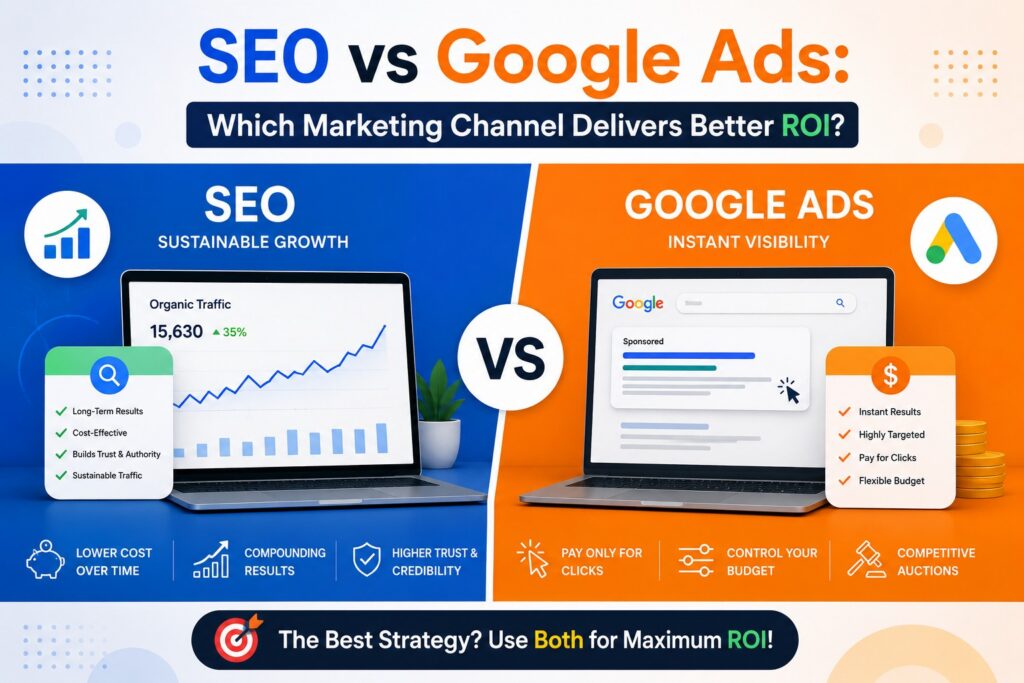
PPC delivers faster results, often within days, while SEO typically takes 6–9 months to gain traction. However, SEO usually provides a higher long-term ROI because organic traffic continues generating leads without ongoing ad spend.
It is the most common question in digital marketing: should you invest in SEO or paid advertising?
Both channels drive traffic. Both generate leads. But they work in fundamentally different ways, on different timelines, and with very different cost structures. Getting this decision wrong can mean burning through the budget without results or missing months of organic growth you can never get back.
This guide gives you a clear, data-backed answer to the SEO vs. paid ads debate — including when to use each, what kind of ROI to realistically expect, and why the best-performing businesses in 2026 are using both in combination.
SEO vs. Paid Ads: The Core Difference
Before comparing returns, it is important to understand what each channel fundamentally does.
SEO (Search Engine Optimisation) means optimising your website, content, and authority so that Google ranks you organically in search results. You do not pay per click. Once you rank, traffic is essentially free and it compounds over time.
Paid Ads (PPC — Pay-Per-Click) means paying Google (or Bing, Meta, LinkedIn) every time someone clicks your ad. You appear immediately at the top of results, but the moment you stop spending, the traffic stops entirely.
| SEO | Paid Ads (PPC) | |
| Time to first results | 3–9 months | 24–72 hours |
| Cost model | Monthly retainer / one-time | Cost per click (ongoing) |
| Traffic when you stop | Continues | Stops immediately |
| Long-term ROI | Very high (748% median) | Moderate (200% average) |
| Lead quality | Higher intent, lower cost | Fast but more expensive per lead |
| Best for | Long-term growth | Immediate lead generation |
Which Delivers ROI Faster? The Honest Answer
Paid ads win on speed. SEO wins on overall return.
If you need leads this week, PPC is your answer. A well-structured Google Ads campaign can be live within 48 hours and generate enquiries the same day. For new businesses, product launches, seasonal campaigns, or urgent sales targets, that immediacy has real value.
However, speed comes at a cost. The average cost per lead from paid search is £97–£181, depending on industry. The moment your budget runs out, so does your visibility.
SEO works the opposite way. It requires patience; most campaigns take 6–9 months before delivering significant returns. But once rankings are established, organic traffic continues flowing without incremental spend. The average cost per lead from organic SEO is approximately £31 roughly 5–6 times cheaper than paid search leads.
The crossover point when SEO begins outperforming PPC in cumulative ROI typically arrives between months 12 and 18 for most UK businesses.
The ROI Data: SEO vs. Paid Ads in 2026
SEO ROI Statistics
- According to First Page Sage, the median SEO ROI is approximately 748%
- SEO delivers 8× the ROI of PPC over the long term (NP Digital, 2026)
- SEO lead close rate: 14.6% versus just 1.7% for outbound marketing — an 8.6× difference in close rate (HubSpot)
- Average cost per organic lead: £31 compared to £181 for PPC leads (First Page Sage / SeoProfy, 2026)
- Organic search drives 53.3% of all website traffic across industries (BrightEdge, 2026)
- B2B companies generate 2× more revenue from organic search than from any other single channel, including paid search and social (BrightEdge)
- Businesses implementing strong SEO save up to 75% on customer acquisition costs long-term compared to paid advertising
Paid Ads (PPC) ROI Statistics
- Average Google Ads ROI: 200% — businesses generate approximately £2 for every £1 spent (WordStream / Google Economic Impact)
- Average UK Google Ads CPC: £1.95 on Search (ppcchief.com, 2026), though this ranges from under £1 for e-commerce to over £7 for legal services
- Average Google Ads conversion rate: 4.4% on Search in the UK (ppcchief.com, 2026)
- 65% of UK SMBs run active PPC campaigns, with typical monthly budgets of £5,000–£9,000
- People who click Google Ads are 50% more likely to convert than organic visitors on highly commercial queries (DemandSage)
- PPC delivers immediate visibility — campaigns can go live within 24–48 hours
The Long-Term ROI Gap
The gap between SEO and PPC ROI widens significantly over time:
| Timeframe | PPC Cumulative ROI | SEO Cumulative ROI |
| Month 1–3 | Immediate but dependent on spend | Minimal — investment phase |
| Month 6 | Moderate, cost-heavy | Starting to show returns |
| Month 12 | Consistent but tied to budget | Beginning to compound |
| Month 24+ | ROI plateaus or declines as CPCs rise | Strong compounding, cost per lead falling |
When to Choose SEO
SEO is the right primary investment when:
- You are building long-term brand authority — sustained organic visibility compounds in ways paid ads never can
- Your customer acquisition costs need to come down — as rankings improve, cost per lead drops dramatically
- You are in a sector where trust matters — research shows that 70–80% of users skip paid ads entirely for certain categories, preferring organic results they perceive as more credible
- You are targeting informational or research-stage queries — buyers researching solutions find you through organic content, not ads
- You want results that survive budget cuts — rankings built over time continue working even if you reduce investment temporarily
- You are a local business — local SEO consistently delivers exceptional ROI (averaging 700%) at lower competition than national PPC campaigns
Industries with highest SEO ROI:
| Industry | Average SEO ROI |
| Real estate | 1,389% |
| Financial services | 1,031% |
| Healthcare | 857% |
| B2B SaaS | 702% |
| Local services (HVAC, trades) | ~500–700% |
| E-commerce | 317% |
When to Choose Paid Ads
PPC is the right primary channel when:
- You need leads immediately — new business, product launch, or urgent revenue target
- You are testing a new market or keyword — PPC gives you instant data on what converts before you invest in long-term SEO
- You are running time-limited promotions — seasonal offers, events, or limited availability campaigns suit PPC perfectly
- Your SEO is already strong — use PPC to capture demand for keywords where you do not yet rank organically
- You are entering a highly competitive space — while SEO builds, PPC maintains visibility during the investment period
- You are retargeting website visitors — paid display and social retargeting is highly effective for warm audiences
Why the Best Businesses Use Both: The Combined Strategy
The question is rarely either/or. The most effective digital marketing strategies treat SEO and PPC as complementary channels, not competing ones.
Here is how leading businesses structure a combined approach:
Phase 1 (Months 1–6): PPC-led with SEO foundation
- Run PPC campaigns immediately to generate leads and revenue while SEO investment begins
- Use PPC data (converting keywords, best-performing ad copy, audience insights) to inform your SEO content strategy
- Begin technical SEO, content creation, and link building
Phase 2 (Months 6–12): SEO begins delivering, PPC refined
- Organic rankings start appearing for target keywords
- Reduce PPC spend on keywords where you are now ranking organically
- Redirect PPC budget toward higher-competition terms, new markets, or retargeting
Phase 3 (12 months+): SEO compounds, PPC becomes strategic
- Organic traffic sustains baseline lead generation cost-effectively
- PPC used selectively for seasonal campaigns, competitor targeting, and new product launches
- Combined strategy delivers total acquisition cost significantly below either channel alone
According to Moz’s research on integrated search strategies, businesses running coordinated SEO and PPC campaigns consistently see stronger overall performance than those relying on a single channel — with the paid data accelerating organic strategy and organic rankings improving Quality Scores and reducing CPCs.
SEO vs. Paid Ads: Industry-Specific Guidance
E-Commerce
- Use PPC for: Product launches, seasonal promotions (Christmas, Black Friday), retargeting cart abandoners, Shopping ads
- Use SEO for: Category pages, buying guides, comparison content, evergreen product descriptions
- SEO delivers 317% ROI for e-commerce — lower than other industries but still significant at scale
Local Services (Trades, Healthcare, Legal, Home Services)
- Local SEO is typically the highest-ROI channel less competitive than national campaigns, high purchase intent, strong community trust signals
- PPC useful for urgent searches (emergency plumber, same-day GP appointment) where immediate visibility matters
- Real-world data from home services businesses shows SEO delivering nearly 5× better return on ad spend compared to paid campaigns
B2B and Professional Services
- Organic search generates 44.6% of all B2B revenue the single largest channel
- B2B buyers research extensively before contacting anyone; SEO content captures them at the research stage
- PPC effective for bottom-of-funnel, high-intent terms and remarketing to past visitors
- 81% of B2B marketers say SEO generates higher-quality leads than PPC
SaaS and Technology
- SEO ROI for B2B SaaS averages 702% with a break-even period of approximately 7 months
- Content-led SEO (tutorials, comparisons, integrations) drives significant qualified traffic
- PPC effective for branded terms, direct competitor campaigns, and free trial sign-up campaigns
The True Cost Comparison
Understanding the real cost of each channel requires looking beyond the obvious numbers.
True Cost of PPC
- Cost per click (varies by industry and competition)
- Agency or in-house management fees (typically 10–20% of ad spend)
- Landing page creation and optimisation
- Ongoing creative costs (ad copy, imagery)
- All traffic stops when spend stops
True Cost of SEO
- Agency monthly retainer or in-house resource
- Content creation costs
- Technical SEO work (usually front-loaded)
- Link building activity
- Traffic continues even if investment temporarily pauses
For a business spending £2,000/month on SEO versus £2,000/month on PPC:
- After 6 months: PPC has generated leads consistently; SEO is beginning to deliver results
- After 12 months: SEO is delivering strong organic traffic; cumulative cost per lead is falling
- After 24 months: SEO’s compounding effect means cost per lead is typically 60–75% lower than PPC, and the channel is largely self-sustaining
As Search Engine Land notes, the “traffic-as-an-asset” model of SEO is one of its most underappreciated advantages unlike PPC spend, which depreciates to zero the moment billing stops, SEO investment builds cumulative value over time.
Common Mistakes Businesses Make
Mistake 1: Choosing one channel and abandoning the other entirely The strongest results consistently come from integration, not isolation.
Mistake 2: Expecting SEO to deliver leads within 30 days SEO is a 6–18 month investment. Expecting quick returns leads to premature abandonment before the compounding effect kicks in.
Mistake 3: Running PPC without any SEO investment Without organic authority, you are permanently dependent on paid spend. Any budget cut immediately kills your visibility.
Mistake 4: Not using PPC data to inform SEO strategy Your converting PPC keywords are a goldmine of intelligence for organic content and on-page optimisation. Most businesses treat these channels in complete silos.
Mistake 5: Measuring success too narrowly PPC is easy to attribute; SEO is harder. Do not let attribution difficulty cause you to undervalue organic performance use Google Search Console to track impressions, clicks, and ranking trends alongside conversion data.
Summary: SEO vs. Paid Ads Which Is Right for You?
Choose PPC as your primary channel if:
You need leads within days, not months
You have a specific campaign or promotion with a defined end date
You are entering a new market and need immediate data
Your SEO is already strong and you want additional coverage
Choose SEO as your primary channel if:
You are building long-term, sustainable growth
You want to reduce customer acquisition costs over time
You are in a sector where buyer trust and organic credibility matter
You want marketing assets that continue working without ongoing spend
Use both if:
You have budget for a 12–24 month integrated strategy
You want maximum search visibility across paid and organic
You want PPC data to accelerate and de-risk your SEO investment
The data is clear: SEO delivers superior long-term ROI, while PPC delivers faster initial results. The businesses that grow fastest are those that use paid advertising to generate revenue during the SEO investment period then let organic growth compound while dialling back paid spend strategically.
