Atomic Logo

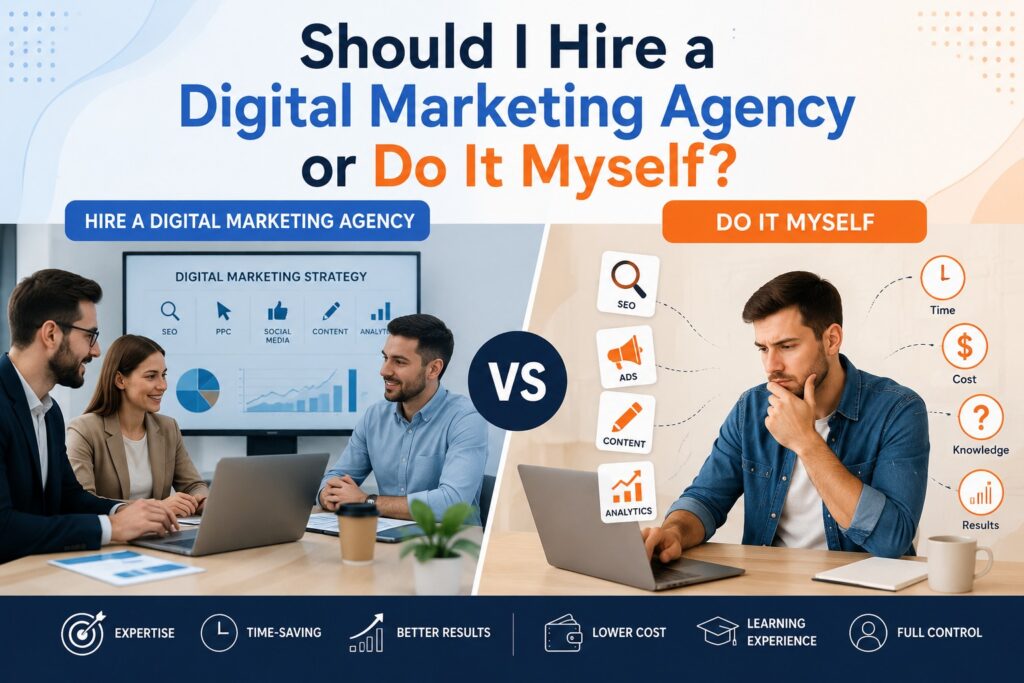
Should I Hire a Digital Marketing Agency or Do It Myself?

This is one of the most common questions small business owners ask — and one of the most searched. In this guide, you will learn not only the answer to the question, but exactly how to write and optimize a blog post on this topic so it ranks on Google Page 1 and gets cited in Google’s AI Overview.

Follow each step in order. Skip none.

Step 1: Understand the Search Intent

Before writing a single word, you need to understand why someone types this query. “Should I hire a digital marketing agency or do it myself?” is a decision-stage query. The person is not just curious — they are about to spend money and want help deciding.

Google classifies this as an Informational + Commercial Investigation query. That means people want an honest comparison, not a sales pitch. If your content reads like an ad for your agency, Google will not rank it highly.

What to do:

•        Search the exact question in an incognito browser window and study the top 10 results

•        Note what formats appear: comparison articles, pros and cons lists, quizzes, or calculators

•        Check the average word count of Page 1 results and aim to match or slightly exceed it

•        Look for a featured snippet or AI Overview box — this tells you Google wants a direct, structured answer

Step 2: Build Your Keyword Strategy

You should not target just one keyword. Build a cluster of related keywords so Google sees your page as a complete, authoritative resource on the topic.

Primary keyword: hire digital marketing agency or DIY — place this in your title, H1, URL, and first paragraph

Secondary keywords: digital marketing agency vs in-house, agency vs freelancer — use in H2 headings

Semantic keywords: cost of hiring a marketing agency, DIY SEO tools, marketing agency red flags — use in body paragraphs

Question keywords: is it worth hiring a marketing agency, how much does a marketing agency cost — use in FAQ section

Tip for AI Overview: Google’s AI pulls from pages that answer multiple related sub-questions in a single well-structured article. Covering your full keyword cluster on one page significantly increases your chance of being cited in the AI Overview panel.

Step 3: Establish E-E-A-T – Experience, Expertise, Authority, Trust

Since Google’s Helpful Content updates, E-E-A-T has become the most important quality signal for decision-stage content. Google wants to rank content written by people who actually know what they are talking about.

•        Experience: Share real examples. Have you worked with an agency? Did you try DIY first? Tell that story.

•        Expertise: Add an author bio with your credentials, years of experience, and a headshot

•        Authority: Cite reputable sources like HubSpot, Statista, or Google’s own documentation

•        Trust: Be honest. Include a Last Updated date. Acknowledge when DIY is the better choice, even if you run an agency

Important: Avoid writing this article as a pitch for your own agency. Google’s quality raters are trained to spot self-serving content. Write it as if you genuinely want to help the reader make the right decision for them.

Step 4: Structure Your Article to Win Featured Snippets

The structure of your article matters as much as the content itself. Google’s algorithm and AI Overview both parse page structure to decide which content to surface.

Use this structure:

•        Hook (first 100 to 150 words): Answer the question directly in 2 to 3 sentences. Do not bury the answer. This section is what gets pulled into featured snippets.

•        Quick comparison table: A simple hire vs DIY table. Scannable content performs well in AI Overview citations.

•        Deep dive sections: When to hire an agency, when to go DIY, cost breakdown, common mistakes, a decision checklist.

•        FAQ section (minimum 6 questions): Use the exact phrasing from Google’s People Also Ask box. Each answer should be 2 to 3 sentences.

•        Clear conclusion: Give a decisive recommendation. Vague endings reduce time on page.

Step 5: Optimize for Google’s AI Overview

Google’s AI Overview appears above organic search results for most comparison and decision queries. Getting cited there can drive significant traffic and brand awareness even if you are not ranking number one organically.

How to get your page cited in AI Overview:

•        Write a direct answer paragraph of 40 to 60 words at the very top of your article. This is the single most effective AI Overview trigger.

•        Use declarative sentences in the format of: X is Y. AI systems favor unambiguous, confident statements over hedged language.

•        Include specific numbers. Mention costs, timeframes, and percentages. Vague content is almost never cited.

•        Use a clear H2 and H3 heading hierarchy. The AI system reads your headings to extract sub-answers.

•        Answer every People Also Ask question explicitly with a 2 to 3 sentence response directly below each question.

•        Keep your page fast and mobile-friendly. Slow or poorly formatted pages are deprioritized for AI Overview citations.

Step 6: Fix Your Technical SEO

Great content on a slow or broken website will not rank. Technical SEO is the foundation everything else sits on. Check every item on this list before publishing.

•        Core Web Vitals: Largest Contentful Paint under 2.5 seconds, Interaction to Next Paint under 200ms, Cumulative Layout Shift under 0.1. Check at pagespeed.web.dev.

•        URL: Use a clean, readable URL such as /hire-digital-marketing-agency-vs-diy/ with your main keyword included

•        Title tag: Keep it under 60 characters and place the primary keyword near the beginning

•        Meta description: Write 150 to 160 characters that include the keyword naturally and give the reader a reason to click

•        HTTPS: Your site must have a valid SSL certificate. Mixed content warnings will hurt your trust signals.

•        Internal links: Link to this article from at least 3 to 5 other relevant posts already on your site

•        Mobile: Test your page on a phone. Over 60 percent of Google searches happen on mobile devices.

Step 7: Build Topical Authority with a Content Cluster

A single article rarely wins competitive keywords on its own. Google rewards websites that cover a topic comprehensively across multiple linked pages. This is called a content cluster strategy.

Your pillar page: Should I hire a digital marketing agency or do it myself? (this article)

Supporting articles to write and link back to this page:

•        How much does a digital marketing agency cost in 2025?

•        Best DIY marketing tools for small businesses

•        Signs you have outgrown DIY marketing

•        How to vet and hire a digital marketing agency

•        In-house marketing team vs agency: a full cost comparison

•        Digital marketing agency red flags to avoid

Step 8: Earn Quality Backlinks

Backlinks remain one of Google’s top three ranking factors. One link from a respected marketing publication is worth far more than hundreds of low-quality directory links.

•        Digital PR: Publish original research, a survey, or a data study that other sites want to cite. For example, survey 200 small business owners about their marketing spend and pitch the findings to marketing publications.

•        HARO and Connectively: Sign up to respond to journalist queries as a marketing expert. This earns editorial links from news sites.

•        Guest posting: Write articles for established marketing blogs such as Moz, Search Engine Journal, or Neil Patel’s blog with a contextual link back to your guide.

•        Broken link building: Find broken links on competitor resource pages and reach out to offer your article as a replacement.

•        Avoid: Buying links, private blog networks, and link farms. These tactics risk Google penalties that can take months to recover from.

Step 9: Add Schema Markup

Schema markup is code you add to your page that helps Google and AI systems understand exactly what your content is about. It does not directly boost rankings but it makes your content eligible for rich results, which increase click-through rates significantly.

•        Article schema: Identifies your page as editorial content and includes author name, publish date, and last modified date

•        FAQPage schema: Makes your FAQ section eligible to appear as expanded accordion results directly in Google search, taking up more screen space

•        BreadcrumbList schema: Shows your site navigation path in search results and improves site structure signals

•        HowTo schema: If any section of your article walks through steps, this schema can trigger a rich carousel result in Google

Step 10: Measure and Refresh Every 30 Days

SEO is not a one-time task. The pages that hold their rankings are the ones that get updated regularly. Set a monthly review reminder for this article.

•        Check Google Search Console every month for impressions, clicks, click-through rate, and average position for your target keyword

•        Track your keyword rankings weekly using a tool like Semrush, Ahrefs, or SE Ranking

•        Search your target keyword in an incognito Chrome browser once a month to check if you are being cited in the AI Overview

•        Update any statistics, prices, or tool recommendations that have changed in the past 6 to 12 months

•        Review your engagement rate and scroll depth in Google Analytics 4. If users are leaving quickly, your content needs improvement.

Step 11: The Actual Answer — Agency vs. DIY

Now for the answer your readers came for. Write this section clearly and decisively — fence-sitting content does not earn AI Overview citations or featured snippets.

Hire a digital marketing agency if:

•        Your monthly marketing budget is $3,000 or more

•        You need results within 90 days and do not have time to learn

•        You are scaling across multiple channels at once (SEO, paid ads, email, social)

•        Your time is worth more than $150 per hour and marketing pulls you away from core work

•        You have already tried DIY and hit a growth ceiling

Do it yourself if:

•        You are pre-revenue or generating under $5,000 per month

•        You operate in a niche you understand deeply and can create genuine, expert content

•        You can commit 15 or more hours per week to learning and executing marketing tasks

•        You have a 6 to 12 month runway and can afford to wait for organic results to compound

•        You are a local business with a straightforward audience and limited geographic reach

The honest answer: Most businesses do best with a hybrid model. Manage your own content, social media, and email marketing — you know your customers better than any agency will. Outsource technical SEO, paid advertising, and data analysis to specialists who use those tools every day.

Whatever you decide, avoid paralysis. Pick a direction, start executing, measure what happens, and adjust. The only wrong answer is doing nothing.

Atomic Artisans Team

June 4, 2026

digital marketing

Agency vs In-House Marketing

AI Overviews

AI Search

AI SEO

backlink building

Best Digital Marketing Agency

Blog Writing Services

Content Marketing

custom website development

Digital Marketing

This is one of the most common questions small business owners ask — and one of the most searched. In this guide, you will learn not only the answer to the question, but exactly how to write and optimize a blog post on this topic so it ranks on Google Page 1 and gets cited in Google’s AI Overview.

Follow each step in order. Skip none.

Step 1: Understand the Search Intent

Before writing a single word, you need to understand why someone types this query. “Should I hire a digital marketing agency or do it myself?” is a decision-stage query. The person is not just curious — they are about to spend money and want help deciding.

Google classifies this as an Informational + Commercial Investigation query. That means people want an honest comparison, not a sales pitch. If your content reads like an ad for your agency, Google will not rank it highly.

What to do:

•        Search the exact question in an incognito browser window and study the top 10 results

•        Note what formats appear: comparison articles, pros and cons lists, quizzes, or calculators

•        Check the average word count of Page 1 results and aim to match or slightly exceed it

•        Look for a featured snippet or AI Overview box — this tells you Google wants a direct, structured answer

Step 2: Build Your Keyword Strategy

You should not target just one keyword. Build a cluster of related keywords so Google sees your page as a complete, authoritative resource on the topic.

Primary keyword: hire digital marketing agency or DIY — place this in your title, H1, URL, and first paragraph

Secondary keywords: digital marketing agency vs in-house, agency vs freelancer — use in H2 headings

Semantic keywords: cost of hiring a marketing agency, DIY SEO tools, marketing agency red flags — use in body paragraphs

Question keywords: is it worth hiring a marketing agency, how much does a marketing agency cost — use in FAQ section

Tip for AI Overview: Google’s AI pulls from pages that answer multiple related sub-questions in a single well-structured article. Covering your full keyword cluster on one page significantly increases your chance of being cited in the AI Overview panel.

Step 3: Establish E-E-A-T – Experience, Expertise, Authority, Trust

Since Google’s Helpful Content updates, E-E-A-T has become the most important quality signal for decision-stage content. Google wants to rank content written by people who actually know what they are talking about.

•        Experience: Share real examples. Have you worked with an agency? Did you try DIY first? Tell that story.

•        Expertise: Add an author bio with your credentials, years of experience, and a headshot

•        Authority: Cite reputable sources like HubSpot, Statista, or Google’s own documentation

•        Trust: Be honest. Include a Last Updated date. Acknowledge when DIY is the better choice, even if you run an agency

Important: Avoid writing this article as a pitch for your own agency. Google’s quality raters are trained to spot self-serving content. Write it as if you genuinely want to help the reader make the right decision for them.

Step 4: Structure Your Article to Win Featured Snippets

The structure of your article matters as much as the content itself. Google’s algorithm and AI Overview both parse page structure to decide which content to surface.

Use this structure:

•        Hook (first 100 to 150 words): Answer the question directly in 2 to 3 sentences. Do not bury the answer. This section is what gets pulled into featured snippets.

•        Quick comparison table: A simple hire vs DIY table. Scannable content performs well in AI Overview citations.

•        Deep dive sections: When to hire an agency, when to go DIY, cost breakdown, common mistakes, a decision checklist.

•        FAQ section (minimum 6 questions): Use the exact phrasing from Google’s People Also Ask box. Each answer should be 2 to 3 sentences.

•        Clear conclusion: Give a decisive recommendation. Vague endings reduce time on page.

Step 5: Optimize for Google’s AI Overview

Google’s AI Overview appears above organic search results for most comparison and decision queries. Getting cited there can drive significant traffic and brand awareness even if you are not ranking number one organically.

How to get your page cited in AI Overview:

•        Write a direct answer paragraph of 40 to 60 words at the very top of your article. This is the single most effective AI Overview trigger.

•        Use declarative sentences in the format of: X is Y. AI systems favor unambiguous, confident statements over hedged language.

•        Include specific numbers. Mention costs, timeframes, and percentages. Vague content is almost never cited.

•        Use a clear H2 and H3 heading hierarchy. The AI system reads your headings to extract sub-answers.

•        Answer every People Also Ask question explicitly with a 2 to 3 sentence response directly below each question.

•        Keep your page fast and mobile-friendly. Slow or poorly formatted pages are deprioritized for AI Overview citations.

Step 6: Fix Your Technical SEO

Great content on a slow or broken website will not rank. Technical SEO is the foundation everything else sits on. Check every item on this list before publishing.

•        Core Web Vitals: Largest Contentful Paint under 2.5 seconds, Interaction to Next Paint under 200ms, Cumulative Layout Shift under 0.1. Check at pagespeed.web.dev.

•        URL: Use a clean, readable URL such as /hire-digital-marketing-agency-vs-diy/ with your main keyword included

•        Title tag: Keep it under 60 characters and place the primary keyword near the beginning

•        Meta description: Write 150 to 160 characters that include the keyword naturally and give the reader a reason to click

•        HTTPS: Your site must have a valid SSL certificate. Mixed content warnings will hurt your trust signals.

•        Internal links: Link to this article from at least 3 to 5 other relevant posts already on your site

•        Mobile: Test your page on a phone. Over 60 percent of Google searches happen on mobile devices.

Step 7: Build Topical Authority with a Content Cluster

A single article rarely wins competitive keywords on its own. Google rewards websites that cover a topic comprehensively across multiple linked pages. This is called a content cluster strategy.

Your pillar page: Should I hire a digital marketing agency or do it myself? (this article)

Supporting articles to write and link back to this page:

•        How much does a digital marketing agency cost in 2025?

•        Best DIY marketing tools for small businesses

•        Signs you have outgrown DIY marketing

•        How to vet and hire a digital marketing agency

•        In-house marketing team vs agency: a full cost comparison

•        Digital marketing agency red flags to avoid

Step 8: Earn Quality Backlinks

Backlinks remain one of Google’s top three ranking factors. One link from a respected marketing publication is worth far more than hundreds of low-quality directory links.

•        Digital PR: Publish original research, a survey, or a data study that other sites want to cite. For example, survey 200 small business owners about their marketing spend and pitch the findings to marketing publications.

•        HARO and Connectively: Sign up to respond to journalist queries as a marketing expert. This earns editorial links from news sites.

•        Guest posting: Write articles for established marketing blogs such as Moz, Search Engine Journal, or Neil Patel’s blog with a contextual link back to your guide.

•        Broken link building: Find broken links on competitor resource pages and reach out to offer your article as a replacement.

•        Avoid: Buying links, private blog networks, and link farms. These tactics risk Google penalties that can take months to recover from.

Step 9: Add Schema Markup

Schema markup is code you add to your page that helps Google and AI systems understand exactly what your content is about. It does not directly boost rankings but it makes your content eligible for rich results, which increase click-through rates significantly.

•        Article schema: Identifies your page as editorial content and includes author name, publish date, and last modified date

•        FAQPage schema: Makes your FAQ section eligible to appear as expanded accordion results directly in Google search, taking up more screen space

•        BreadcrumbList schema: Shows your site navigation path in search results and improves site structure signals

•        HowTo schema: If any section of your article walks through steps, this schema can trigger a rich carousel result in Google

Step 10: Measure and Refresh Every 30 Days

SEO is not a one-time task. The pages that hold their rankings are the ones that get updated regularly. Set a monthly review reminder for this article.

•        Check Google Search Console every month for impressions, clicks, click-through rate, and average position for your target keyword

•        Track your keyword rankings weekly using a tool like Semrush, Ahrefs, or SE Ranking

•        Search your target keyword in an incognito Chrome browser once a month to check if you are being cited in the AI Overview

•        Update any statistics, prices, or tool recommendations that have changed in the past 6 to 12 months

•        Review your engagement rate and scroll depth in Google Analytics 4. If users are leaving quickly, your content needs improvement.

Step 11: The Actual Answer — Agency vs. DIY

Now for the answer your readers came for. Write this section clearly and decisively — fence-sitting content does not earn AI Overview citations or featured snippets.

Hire a digital marketing agency if:

•        Your monthly marketing budget is $3,000 or more

•        You need results within 90 days and do not have time to learn

•        You are scaling across multiple channels at once (SEO, paid ads, email, social)

•        Your time is worth more than $150 per hour and marketing pulls you away from core work

•        You have already tried DIY and hit a growth ceiling

Do it yourself if:

•        You are pre-revenue or generating under $5,000 per month

•        You operate in a niche you understand deeply and can create genuine, expert content

•        You can commit 15 or more hours per week to learning and executing marketing tasks

•        You have a 6 to 12 month runway and can afford to wait for organic results to compound

•        You are a local business with a straightforward audience and limited geographic reach

The honest answer: Most businesses do best with a hybrid model. Manage your own content, social media, and email marketing — you know your customers better than any agency will. Outsource technical SEO, paid advertising, and data analysis to specialists who use those tools every day.

Whatever you decide, avoid paralysis. Pick a direction, start executing, measure what happens, and adjust. The only wrong answer is doing nothing.

Share this

whatsapp

Find out our more services

Is Your Business Invisible on AI Search?

Get a free audit of your website’s AI visibility, SEO health, and Google Business Profile — no strings attached.

Learn more

View Our Plans from $99/mo

Quick Fact Check

AI is expected to handle  25% of all global search queries by 2026
Businesses that optimise for AI now will have a 6–12 month head start over competitors.

Source: TheeDigital, Squarespace SEOSpace 2025

FAQ’s

Frequently Asked QuestionsÂ